
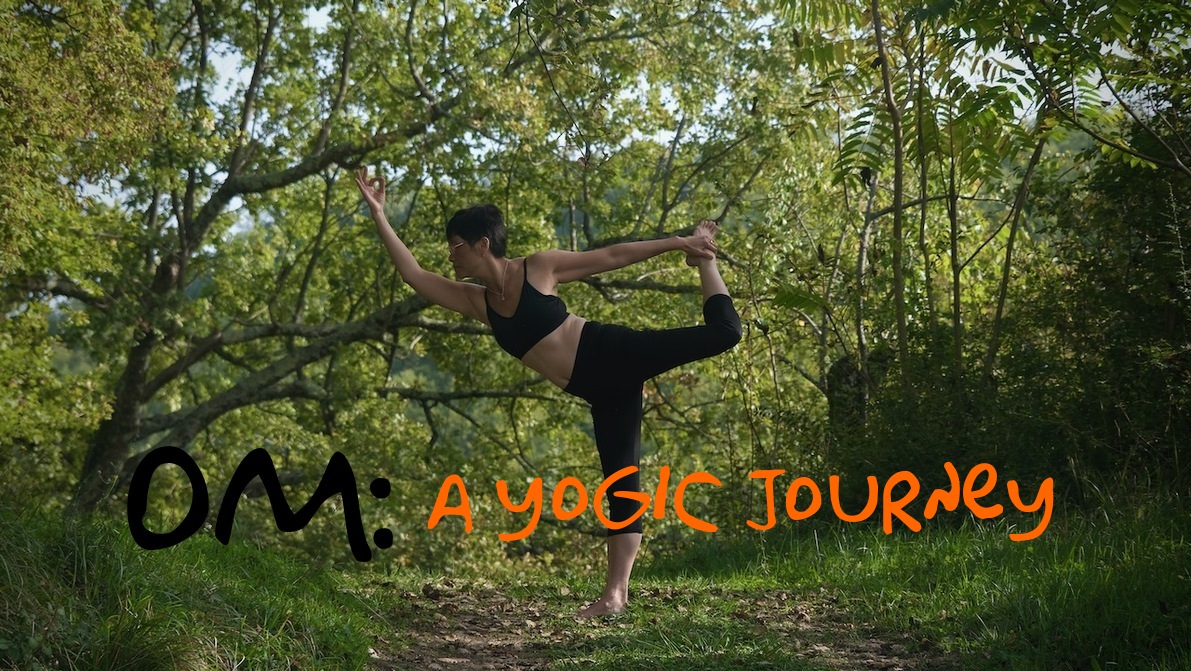
Yoga is the journey of the self,
through the self,
to the self.
– Bhagavad Gita.
Italy 2024
My first encounter with yoga was in the unlikely Harvard athletics complex when I was doing my postdoc, squandering mental energy to write a book on Japanese new left movements. Gene Pacelli, the raw-diet yoga teacher, saved my out-of-balance body. Every Tuesday and Thursday afternoons – snow or shine – we would begin with a rapid-fire sequence of sun salutations before moving on to shoulder stands, seated twists, and various balance poses. My favourite was the end though, the last ten minutes in which we all lay like corpses, drifting off… Energy, everything is energy, he would say to us, all brainy heads pursuing whatever Knowledge in the mecca of the intellect. Cosmic consciousness, whatever that meant, was the last thing on my hyperextended mind!
Life kept me busy and yoga fell by the wayside before making a mysterious reappearance during Covid. In my three-year epic journey across Africa and Europe, I met several yogis who enthusiastically mentioned the YTT, a 200-hour yoga teacher training. Despite my dance background, never in the wildest dream would I entertain the idea of becoming a yoga teacher. But when an opportunity came to spend three weeks doing nothing but yoga at an idyllic farm not far from Rome, I took the plunge. Now or never!
Day 1: Namaste! I Bow to the Divine in You
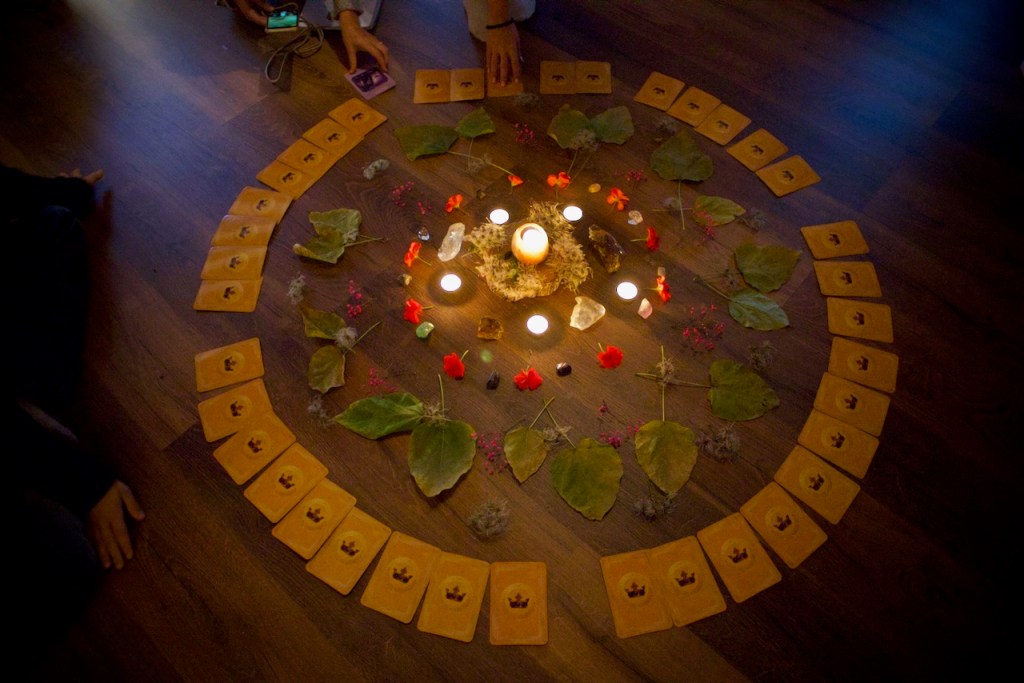
Giddy with excitement, our group of fourteen students hailing from Italy, France, Belgium, Luxembourg, Germany, Poland, Slovakia, and South Africa gathered in the Fiumicino Airport of Rome and made our way to the retreat centre at Italy Farm Stay near Sora. After a welcoming fruit snack, we filed into the shala – our home for the next three weeks – for the opening ceremony.

Namaste: I bow to the divine in you. Coming from disparate backgrounds – lawyers, academics, dancers, graphic designers, healers, first aid responders, and civil servants – we arrived with very different intentions. I was there for the challenge and experience with no plan to teach professionally, though sharing the gift of yoga as a volunteer in communities sounds like a marvellous adventure.
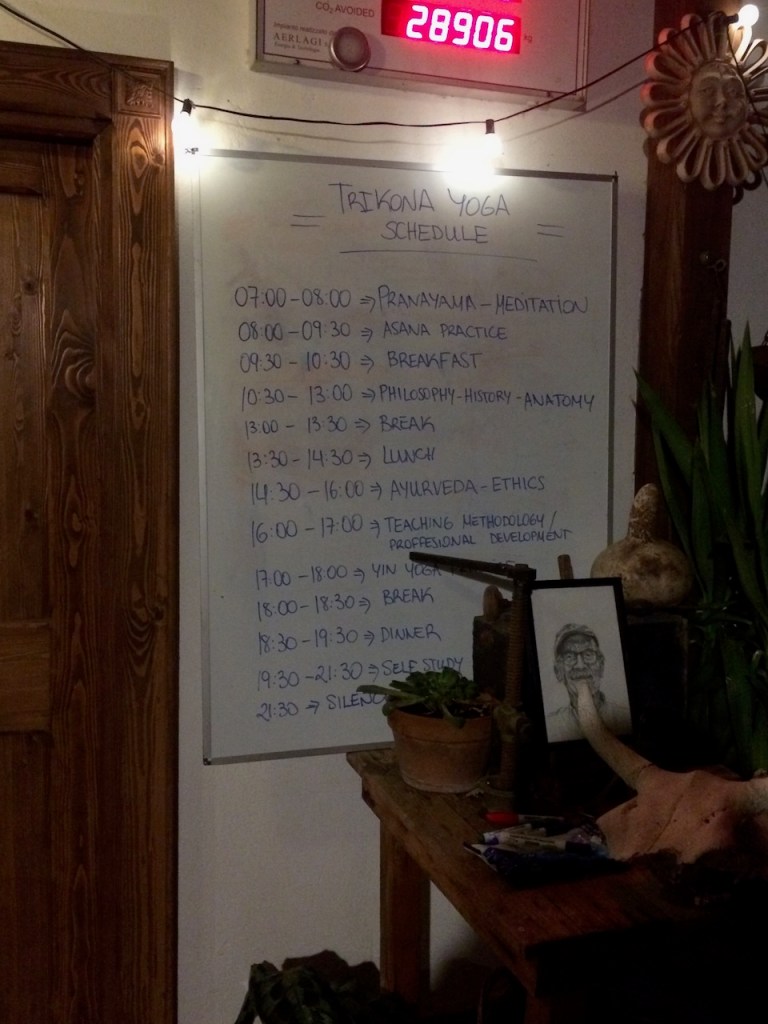
As Chiara and Lorena, the co-founders of Trikona Yoga, presented Shankari, our teacher, and briefed us about the training program, our heads buzzed with questions: 7am meditation? What kinds of asanas? All vegan meals? Lunch at 1:30pm, after meditation, pranayama, asanas, theory, and anatomy? What if… what if… what if…? There was something very intimidating about the entire 200-hour yoga endeavour. While the majority of my classmates have practiced for years, my yoga resume was paper-thin, equalling a grand total of six months, plus sporadic practice in the past twenty years. But now it’s not the time to chicken out! At dinner, we met Alexandra, an Argentinian lawyer-turned-vegan-chef, who would be nourishing us thrice a day for the next three weeks. Antonello, the enterprising, exuberant owner, welcomed us to his beautiful farm and shared his journey rehabilitating the abandoned village…
10pm. Lights out and everyone was in bed. Wake-up call at six! Pronto! We had no idea what was to come…
Day 2: Yoga Citta Vrtti Nirodhah/Yoga is the Cessation of the Waves of the Mind
Om…. Om… Om…
Om Namah Shivaya Gurave
Sad-cid Annanda Muurtaye
Niss-Prapancaaya Shantaaya
Nir-Aalambaya Tejase
“I offer myself to the light, the auspicious lord, who is the true teacher, within and without, who assumes the form of reality, consciousness, and bliss, who is ever present and full of peace, independent in his existence, the vital essence of illumination.” Thus began our daily sadhana/spiritual practice at seven with three Oms – the original cosmic sound – and a short chant giving thanks to light and consciousness to which we owe our precious existence.
Close your eyes, the back is straight, the shoulders slightly back, the legs in full/half lotus or unfolded sukhasana, and the hands in dhyani mudra (left hand on the bottom and the two thumbs touching), Shankari, our teacher, began the meditation instructions. Inhale, and with exhalation, we make our commitment to stillness. Uh! Again, inhale, and exhale. Now we commit to the stillness of the mind…
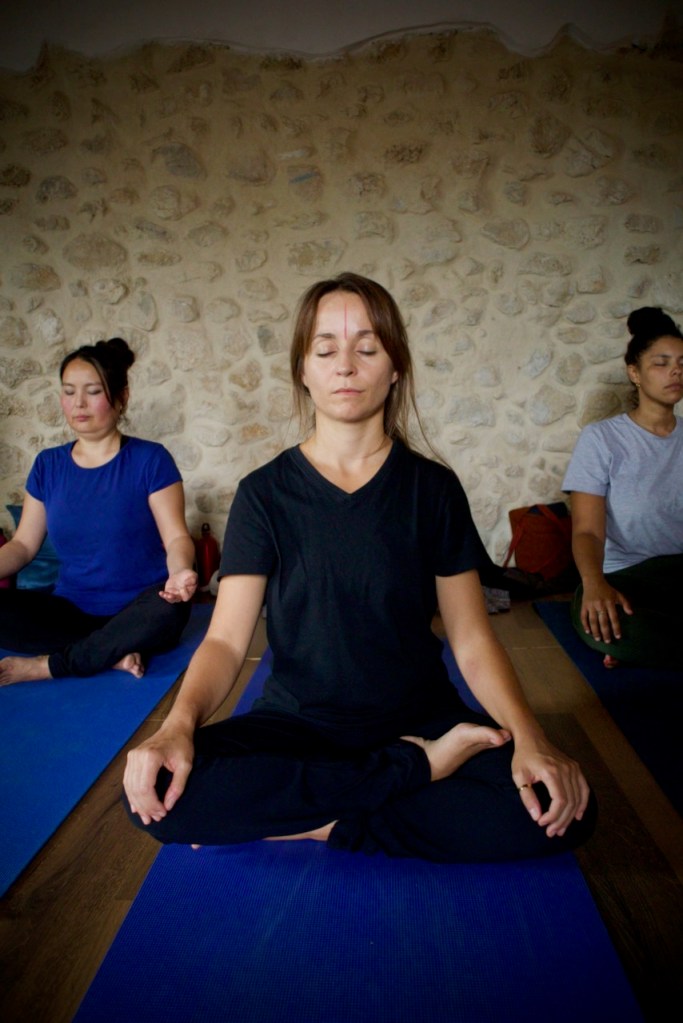
Barely fifteen-minutes in, my entire right leg felt numb. Forget about the full lotus position, 7am or not! Even on a cushion, I struggled to find a comfortable position to sit still. My fractured right knee – the main culprit – unlike the left one, was completely off the ground. As I tried to adjust, my otherwise normal right hip began to hurt. Sitting STILL and NOT thinking were simply not happening. All I could focus on was the pain! Was I the only one?
There is nothing to touch and nothing to be touched. Bring the sense of touch inwards, Shankari continued. There is nothing to taste and nothing to be tasted. Bring the sense of taste inwards. There is nothing to smell and nothing to be smelled. Bring the sense of smell inwards. There is nothing to see and nothing to be seen. Bring the sense of sight inwards. There is nothing to hear and nothing to be heard. Bring the sense of hearing inwards… The refrain, Yoga Citta Vritti Nirodhah/Yoga is the cessation of the waves of the mind, would become my new life motto.
[sorry, no photo here – photographer trying to sit still!]
What a relief when Shankari’s alarm rang. The toughest 30 minutes of the day were over! We moved on to pranayama/breath control, beginning with classic yogic breathing of four counts of abdominal breaths, two of thoracic, and one last through the throat before seven counts of exhalation. Unconscious of our breathing in daily life, we often contract our chest, gasping for air in moments of stress. Yoga helps restore fluidity and balance by blocking, controlling, and redirecting our prana through locks/sections. Now, count on your own: Inhale 4-2-1, exhale 1, 2, 3, 4, 5, 6, 7…
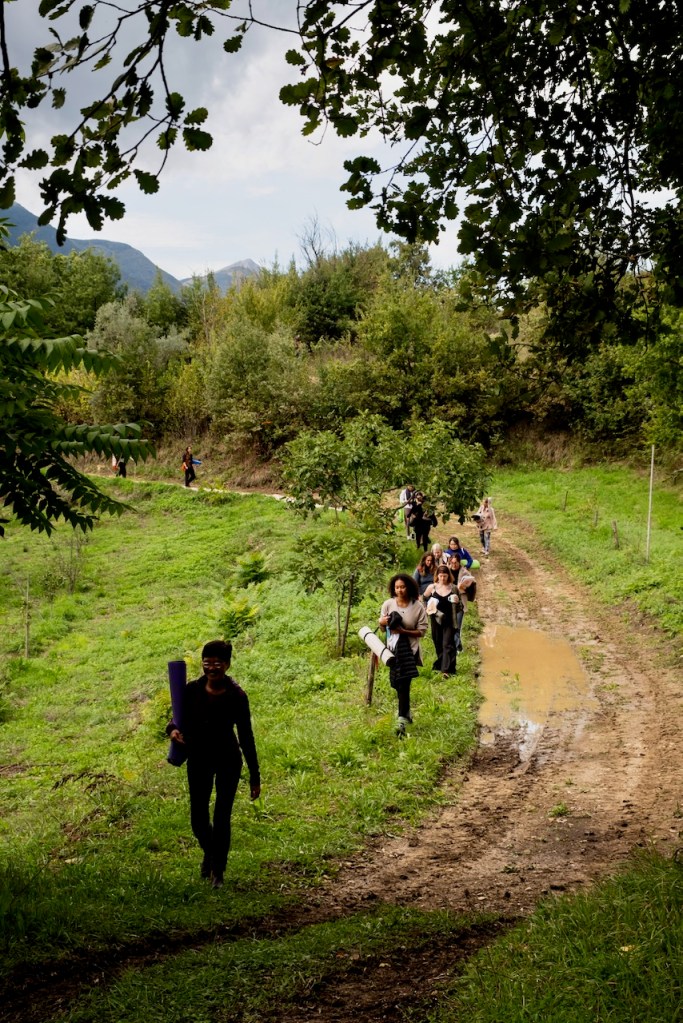
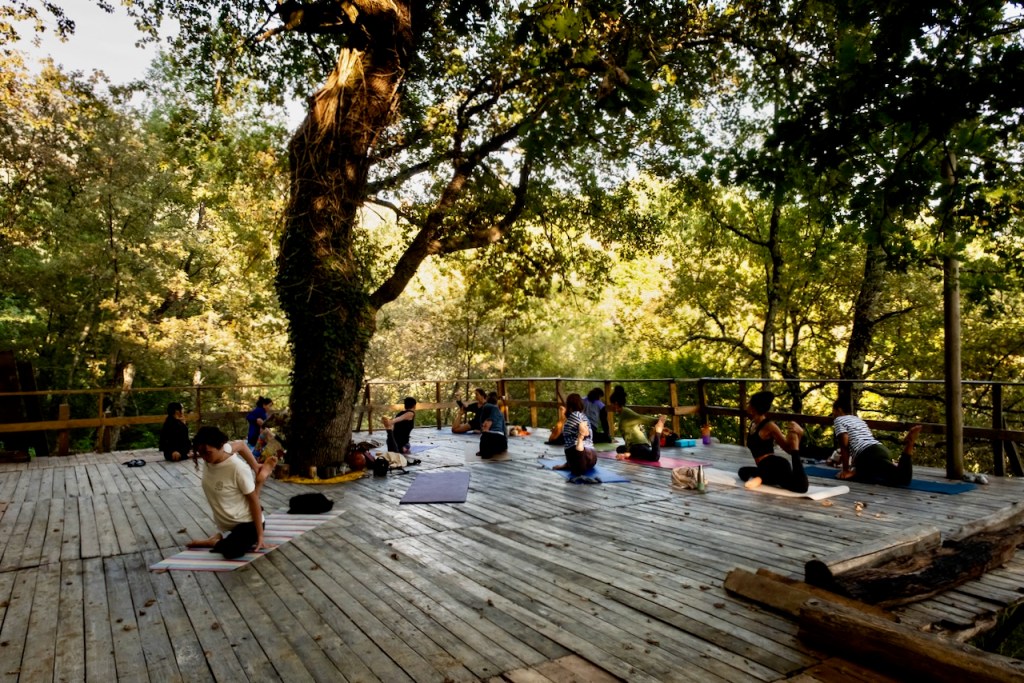
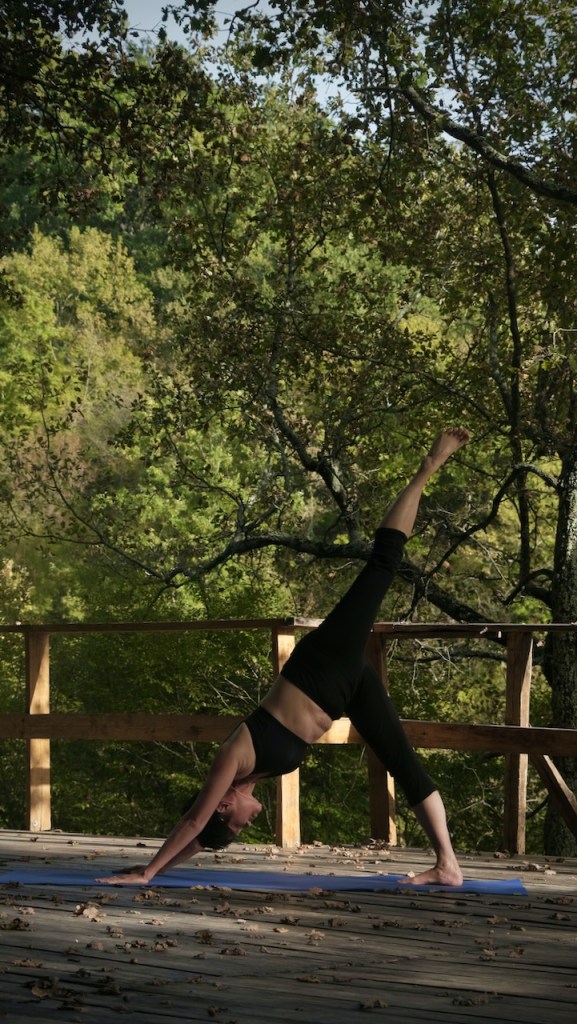
The sun was out and we moved to Yoga Hill, a dream outdoor platform in the woods. Lo and behold, Shankari led six rounds of Surya Namaskara, sun salutations. Suddenly, long forgotten memories of Gene, my awesome first yoga teacher, resurfaced in the twelve asanas still in my muscle memory, and my eyes almost welled with tears. How blessed I felt – I certainly wouldn’t be here without his gift two full decades ago. If only he knew… So much gratitude to all our teachers!
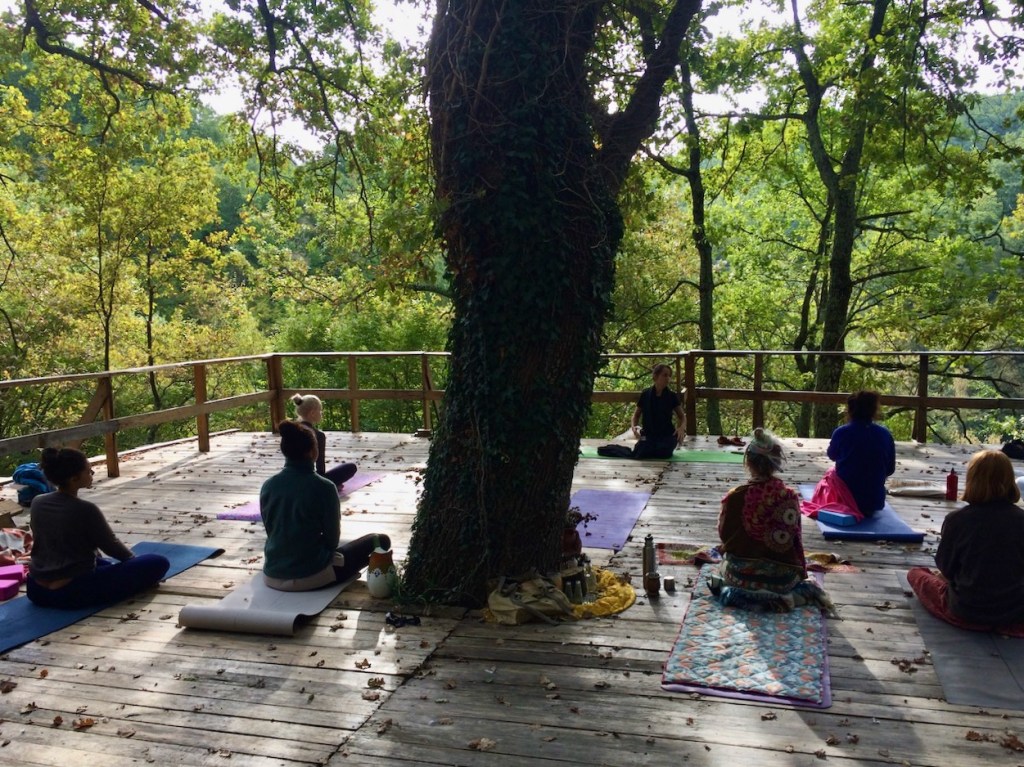
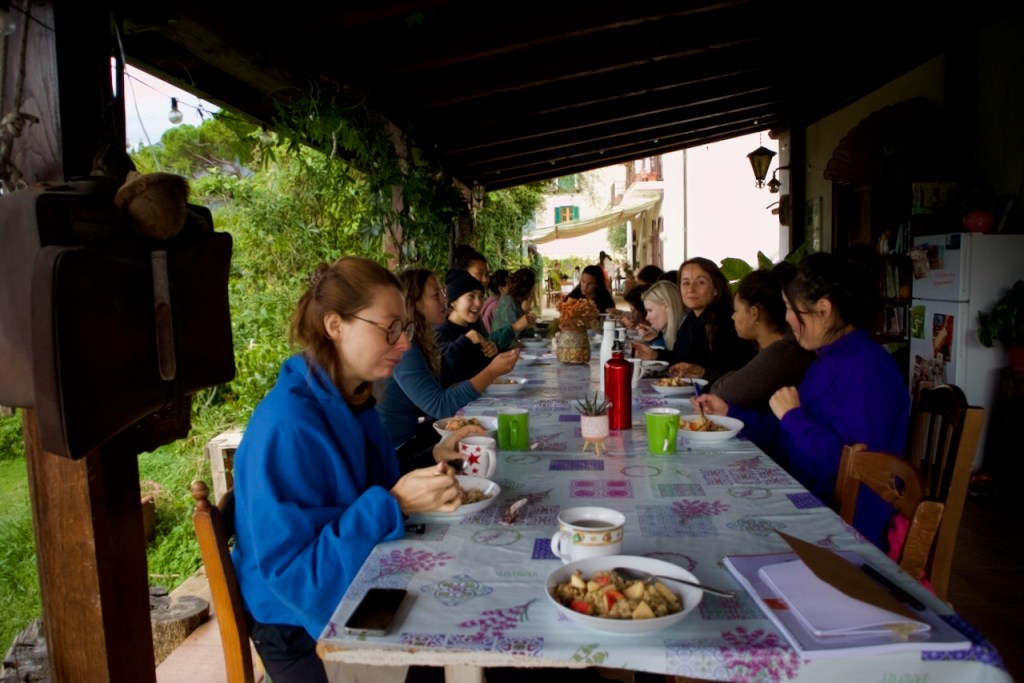
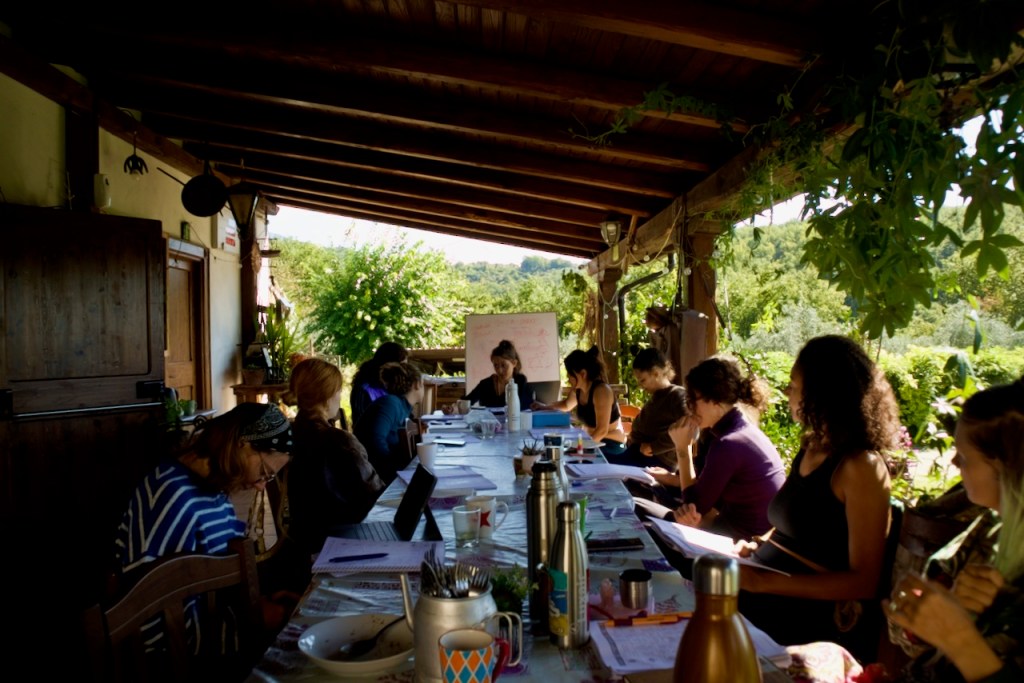
By nine in the morning, I already felt like I had earned my day. After a tasty breakfast, we went straight to philosophy. Yuj in Sanskrit, yoga means junction/union/non-duality, between the individual and universal consciousness, Shankari explained. Hatha means strength, the balance between the sun (ha) and the moon (tha) in us through the mastery of our body and mind. To wrap up our long first exciting day, we did yin yoga with a tonic pawanmuktasana/wind-release sequence before easing into last fifteen minutes of relaxation in my favourite savasana/corpse pose exactly like all those years ago. Absolute bliss!

Day 3: Svasthya/Being Rooted in the Self
After meditation and pranayama, we plunged into the rather advanced Sivananda Rishikesh sequence, beginning with sarvangasana/shoulder stand, then halasana/plough (or karnapidasana/knee to ear), matsyasana/fish, pascimottanasana/seated forward bend, bhujangasana/cobra, salabhasana/locust, dhanurasana/bow, ardha matsyendrasana/seated twist, kakasana/crow, sirsasana/ headstand, trikonasana/triangle, and vrkasana/tree, ending with tadasana/mountain pose. What a spaghetti bowl of Sanskrit names to remember while trying to hold each pose for minutes!


Normally, the sequence begins with a headstand, Shankari said. Why not, just a little inversion at eight in the morning to fire up the day? In full yogic spirit, we walked our feet close to our heads before the room was filled with high-vibrating thuds! Note to self: work on sirsasana!

Pay attention to our body and mind. They’re gifts to us and so we need to respect and take good care of them, even though we are neither the body nor the mind, Shankari reminded us as we all finally lay in corpse pose after a full hour of some heavy duty stretching.
Post a heavenly breakfast of golden milk and chocolate oatmeal with grilled nuts, we eased into Ayurveda, an ancient knowledge of life and healing system based on balance in the body, mind, and spirit through diet and yogic breathing. As pain often results from blocked energy, meditation helps us refocus and re-connect with our own divine consciousness by minimizing external vibrations while pranayama channels better energy flow through breath control. Asanas like headstands open up not only the physical but also the energy body, healing both. It’s all about restoring from imbalance/vikriti to that which is created/prakriti. The end goal of Ayurveda is svasthya/health, as being rooted in the self, like in the motto of Trikona Yoga: All you need is within you!


The morning was not even over. How did we manage to accomplish so much? By blocking external vibrations! In the afternoon, we explored Ashtanga, the eight limbs of yoga: yama/behaviour, niyama/attitude, asana/posture, pranayama/breath energy, pratyahara/sense withdrawal, dharana/concentration, dhyana/meditation, and samadhi/bliss. Together, they set out a living code for yogis. Ahimsa/non-violence, satya/truthfulness, asteya/non-stealing, brahmacharya/abstinence, aparigraph/non-possessiveness, saucha/cleanliness, santosha/contentment, tapas/discipline, svadhyaya/self study, ishvara pranidhana/dedication… Are we supposed to remember all these? I wondered. Yes was the answer!
We ended our second long day with yin yoga through a series of malasana/garland, salabasana/locust, ardha matsyendrasana/seated twist, baddha konasana/butterfly and ananda balasana/happy baby poses. The words of Shankari echoed in my mind. Sarva Dukham/everything is suffering, as the Buddhists say. Yes, we experience pain in life, but suffering – the product of our mind – is optional! No one except ourselves are responsible for our suffering. Never surrender the power to someone to hurt us! We yogis are spiritual warriors.

Day 4: Asanas: Stillness of the Mind, Stability of the Intellect, and Benevolence of the Spirit
I still couldn’t sit still through meditation despite using a block. Something’s definitely blocked! I loved anuloma viloma/alternate breathing, a new soothing pranayama that we learned this morning. In a seated position, with your right hand in vishnu mudra (index and middle fingers bent, thumb on the right nostril) and left hand in chin mudra (thumb and index fingers joined) on your left knee, inhale through the left nostril – hold the breath – before exhaling through the right, and vice versa. Apparently, the most potent component in this technique is kumbhaka/the retention, simulating death, blocking all senses. Beginners start with a 1:1:1 ratio, holding for four to seven counts each, depending on your comfort level, and eventually moving up to 1:4:2 i.e. in for 5 counts, hold for 20, and out for 10…

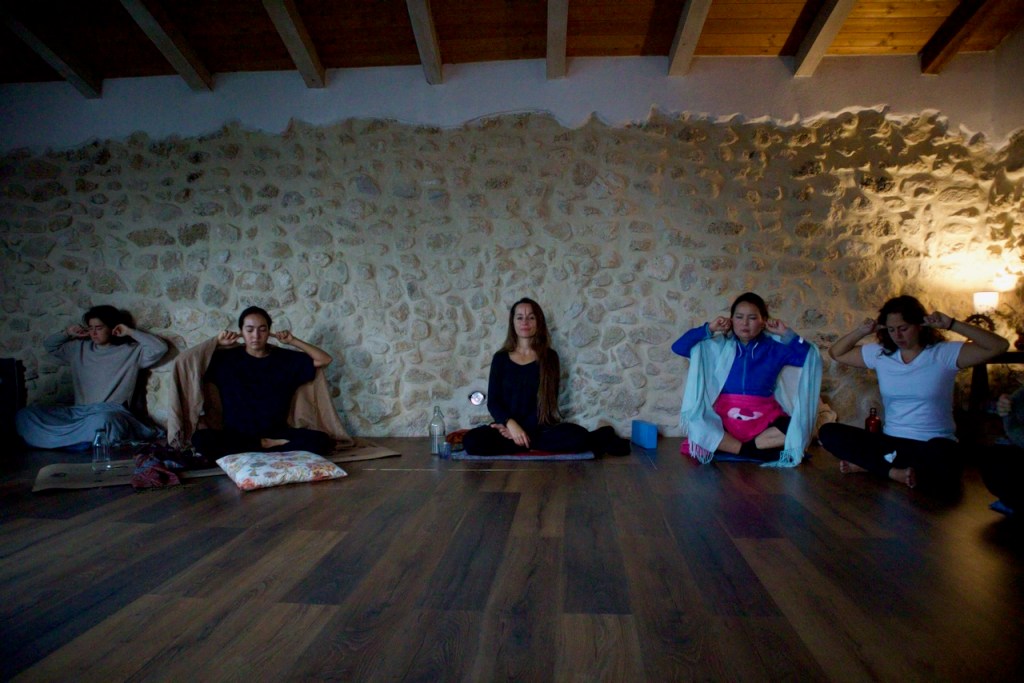
After five rounds of anuloma viloma, we tried an even more fun brahmari/bee breathing method. Sit up straight with our eyes closed, put the index fingers on the ear cartilage, and inhale before making a humming sound in the throat during the elongated exhalation. I love this simple but effective tool that immediately blocks out most external vibrations, bringing focus as well as opening up the heart. Magical!
Yoga is truly humbling. After a series of inverted, standing, and seated asanas, balance is always a challenge. We are so distracted that most of the poses are off limits. Try any of these and hold for, say, ten to twenty minutes! Utkatasana/chair, uttanasana/standing forward bend, parsvottanasana/pyramid, vrkasana/tree, garudasana/eagle, navasana/boat, malasana/garland, virabhadrasana/warrior and viparita virabhadrasana/reverse warrior, ardha chandrasana/half moon, utthita hasta padangusthasana/standing hand to toe, kakasana/crow, adho mukha vrksasana/hand stand, or the ultimate sirsasana/headstand! Whether you want to work on your ego, anger, heartbreak, pain or trauma – or have an important decision to make – try, say, the humbling half moon pose or hold warrior III, and your opened heart might tell you something!
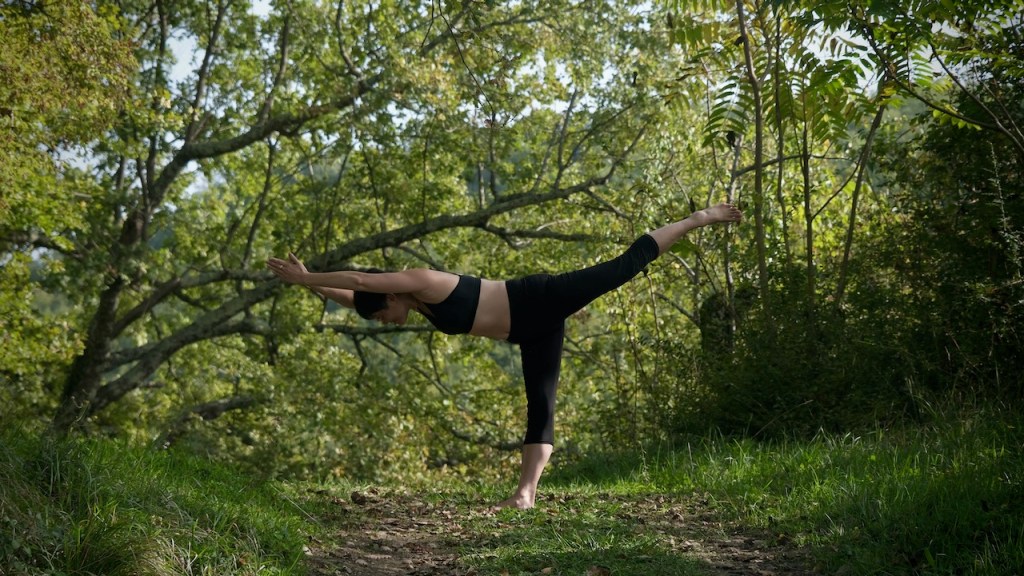
The rest of the day was all theory. If nothing else, you should at least remember these definitions of yoga! Shankari said.
Yoga citta vrtti nirodhah/Yoga is the cessation of the waves of the mind.
– Pantajali, Yoga Sutra 1.2
Tapas Svadhyaya Isuarapranidhavan kriya/Discipline, self study, devotion is the action of yoga.
– Bhagavad Gita 2.48
Samatvam yoga uchyate/Yoga is stability of the mind.
-Bhagavad Gita 2.48
Yoga karmasau kaoshalam/Yoga is excellence in action.
– Bhagavad Gita 2.50
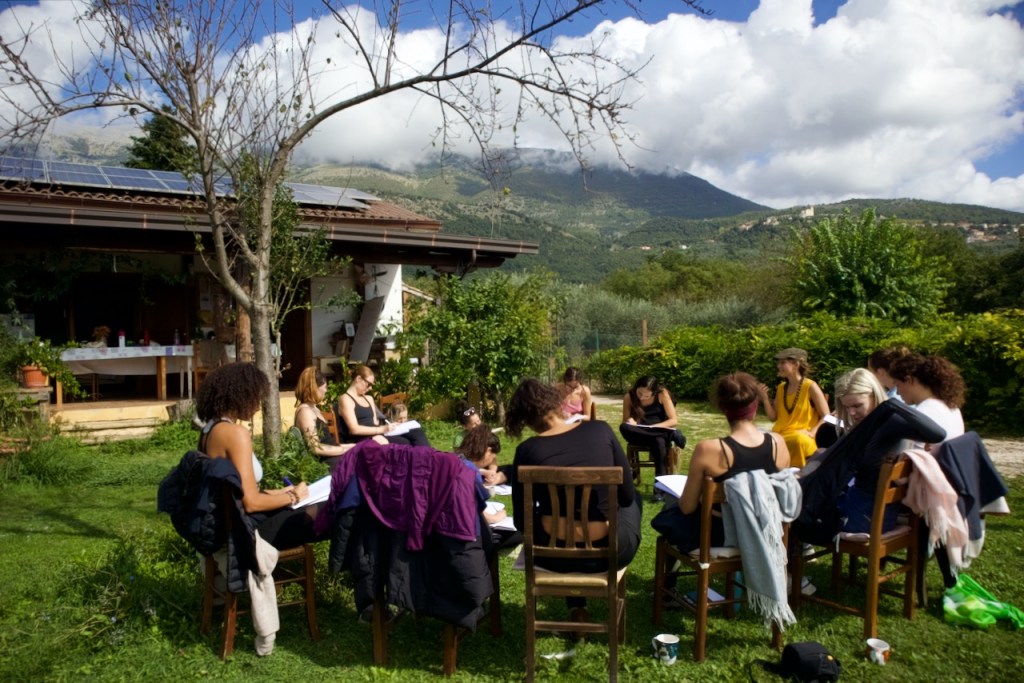
Day 5: Sat Kriya/Yoga Actions
This morning, we advanced to kapalabathi/”skull shining/breath of fire” fast, forceful exhalations that I had learned from a previous yoga teacher. Sit on the floor with a straight back, begin with a few normal breaths to bring awareness. Then with the upper body slightly leaning forward, take a long inhalation through the abdomen, and exhale 20 quick, forceful breaths, feeling the contraction of the abdominal muscles each time. Pace the exhalations slowly at first, accelerating only after managing to breathe properly. Quite a few of us struggled here, not realizing how blocked emotions in the lower chakras had made us habitually breathe “inefficiently” through the chest and throat. This is a mother-of-all pranayama improving sinuses and asthma, metabolism and blood circulation, digestion and liver, guts, lungs, and abdomen, mood swings and anxiety, immunity and even weight loss. Recommend!
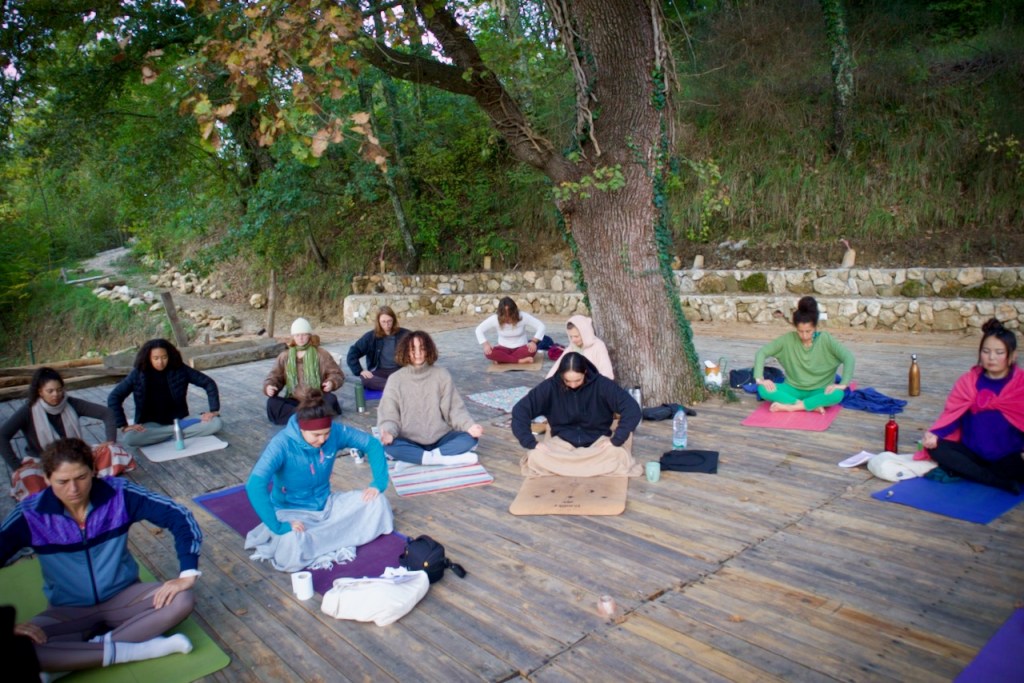
Now that we were all fired up through kapalabathi, it’s time for a head stand. Lo and behold, with Shankari’s encouragement, I was able to hold it for a nanosecond before tumbling down. My kakasana/crow pose looked more like a frog though. Note to self: after YTT, try weightlifting!
After breakfast, it was all about yoga cleansing: sat kriya. I tried nose cleaning at a fellow yogi’s home in Calgary and never caught a cold again. This morning, Shankari took us to new heights of yogic discipline through videos of nostril thread pulling and vastra dhauti/cloth swallowing etc. It’s not compulsory! she explained, to our great relief.

With the cleansing business done, we moved to other layers of our mind and body “onion” called koshas/sheaths, beginning with the physical body and moving inward to the core of the self, the bliss body. With me? Shankari asked. We exchanged bewildered glances, being lost in the koshas and chakras. Which kosha would a head stand reach, I wondered? I had to look harder into the onion!
I loved ending a long day with pawamuktasana and a final relaxation bonus in the most compassionate savasana pose with absolutely nothing to do but lying there, enjoying it all…

Day 6: Opening up the Chakras/Wheels of Lifeforce
After meditation, pranayama, and six rounds of Surya Mamaskara/sun salutations, we eased into a combination of lying and inverted positions, ending with trikonasana/triangle and vrkasana/tree pose. By the end of our first week, we managed to find better balance and hold the asanas a bit longer without hyperventilating.

Time to open up the chakras, the energy wheels key to enlightenment. Our body contains 72,000 energy channels in seven major chakras, from the muladhara/root chakra at the base of the spine and swadhistana/sacral chakra in the lower abdomen to the manipura/solar plexus, anahata/heart, vishuddha/throat, and anja/third eye, ending in sahasara/crown chakra. Specific asanas are particularly effective against blocked energy in certain areas. Try the rabbit pose that works on all the chakras from the solar plexus up, softening your anger. Or, if you have a broken heart, kneel and bend like a camel to open your anahata chakra. Consumed by lust? Press your banana (honeypot for ladies) with your heel in siddhasana and meditate for, say, six hours to activate your muladhara and channel your prana from swadhistana all the way up to the crown. Yogis never allow emotions to control us, Shankari said. Hatha yoga means strength!
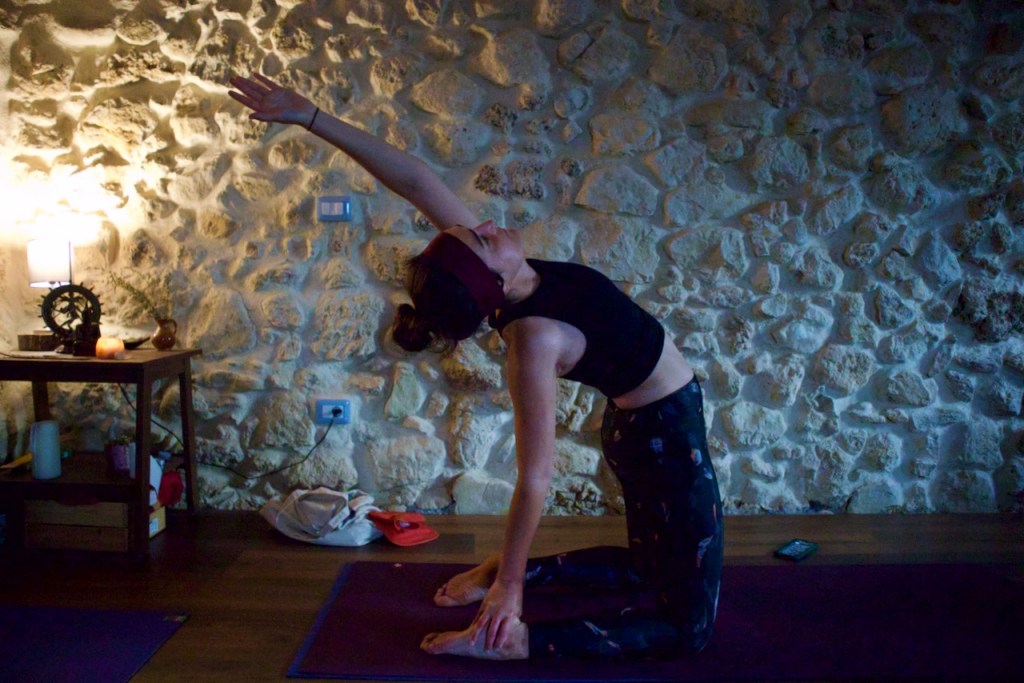
We Ommed through the afternoon in theory, realizing the potential to one day reach turya – the top dot in the symbol 🕉 – the ultimate source/truth from which everything emerged, a fourth state of consciousness of unity/non-duality, beyond thought, love, and will – beyond wakefulness, dream, and deep sleep. Uh, om, ok!
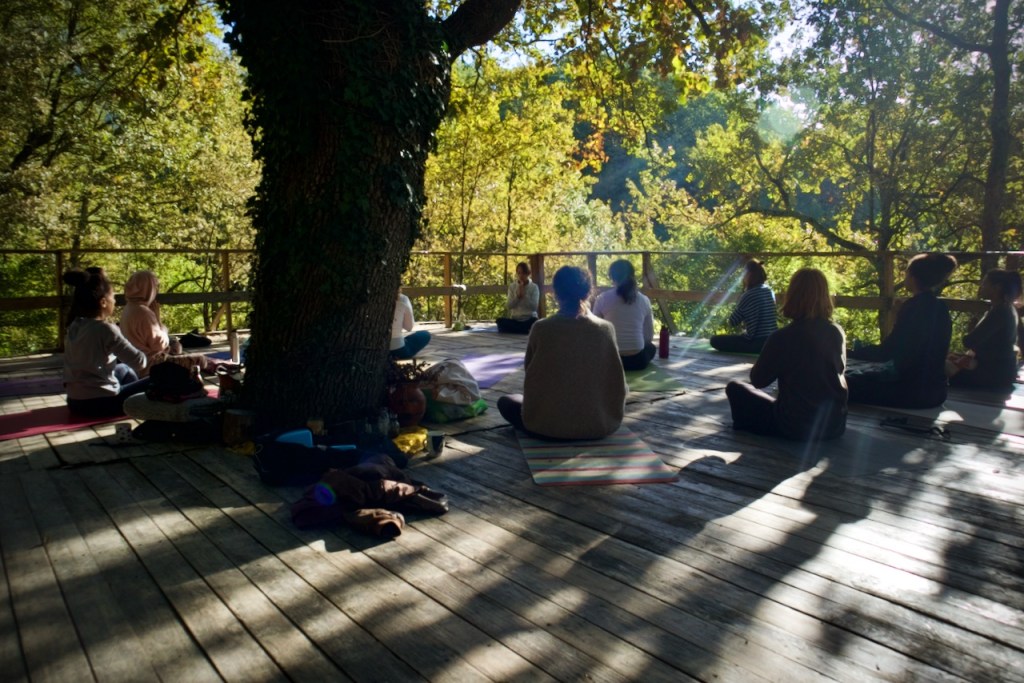
We headed back to the platform to do some much needed hip-opening in badhakonasana/butterfly and kapotasana/pigeon poses. As we reached supta virasana/reclining hero, all of a sudden I was paralyzed with fear for God knew what reason and stopped mid-track. With tension in my right once-fractured knee, gliding both legs outwards until my hip touched the ground was stretching it. Shankari saw how I struggled to lower my spine backwards and came to hold my hands. I exhaled, with my back reaching the floor for a split second before immediately releasing for fear of a cramp. The pose was not advised for people with knee injuries. No brainer. Was I afraid of something else though? What’s blocking me from being a heroine? Apparently, it’s a pose about surrendering! Note to self: work on unblocking my supta virasana!

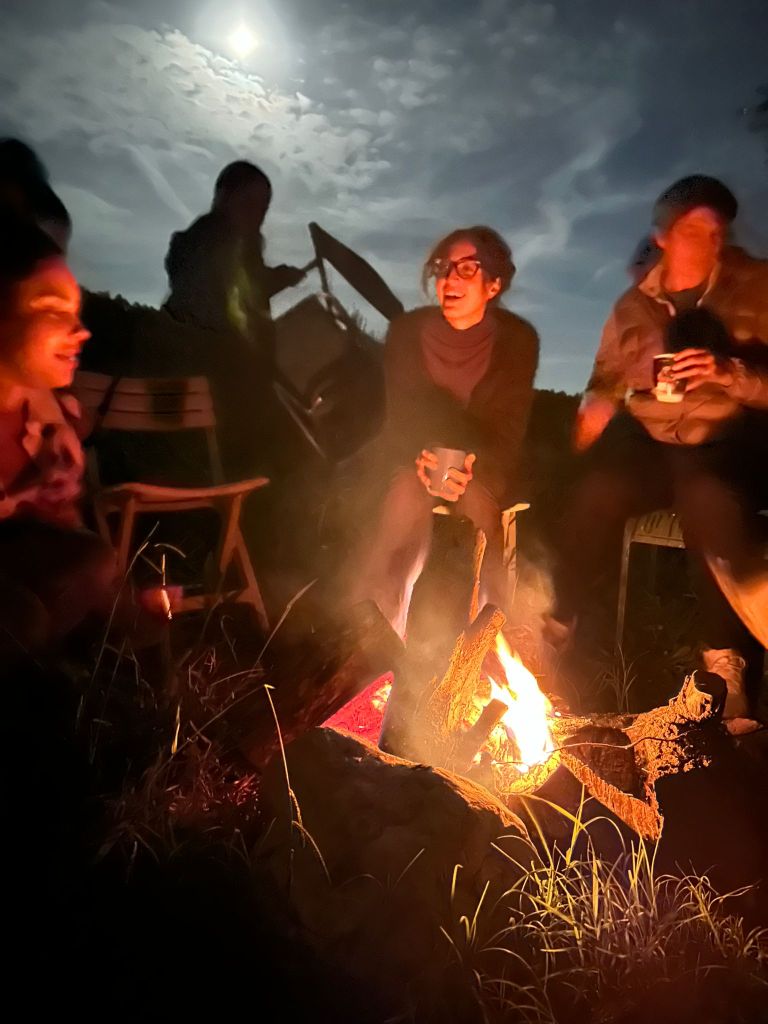
Our YTT coincided with the auspicious Dussehra festival to celebrate the Hindu gods, Durga and Rama, triumphing light over darkness. Shankari and Dasha prepared a roaring fire in the beautiful autumnal evening and we chanted with all our opened chakras appreciative salutations to the almighty Durga Ma. Nothing happened by chance; we were all simply grateful to be there tonight.
Day 7: Mantras/Tuning the Mind and Singing Your Song
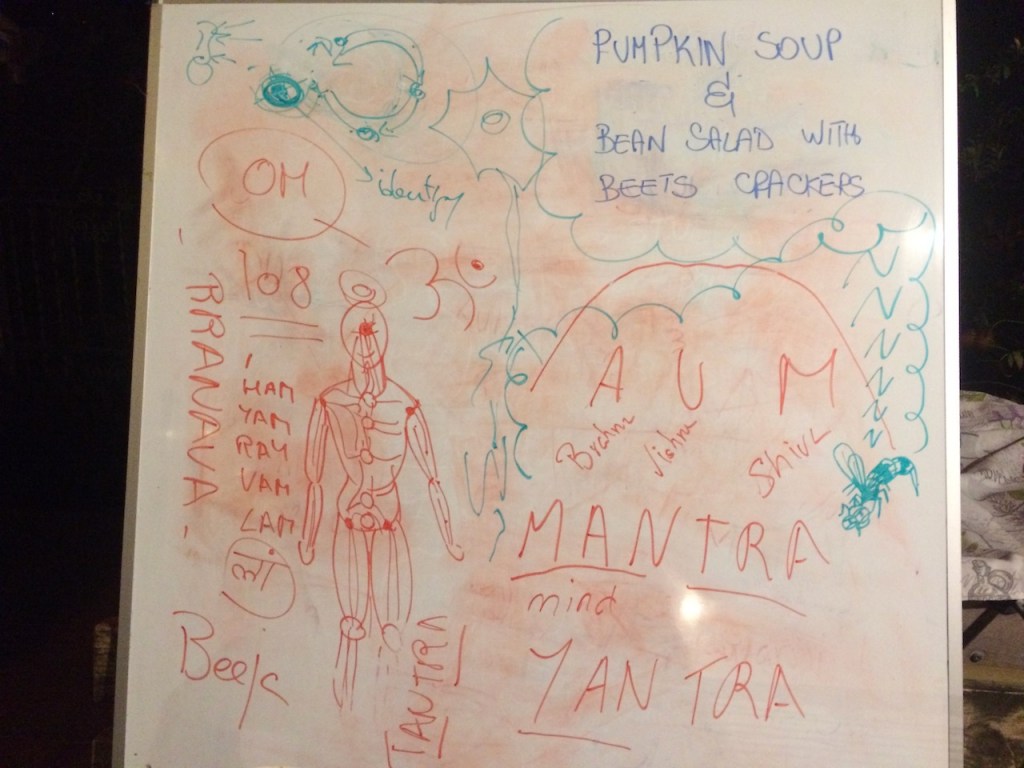
It’s Jackie’s birthday and we surprised her with an impromptu dance first thing in the morning before meditation, pranayama, and sun salutations! After chanting all week as part of our practice, finally we unpacked the mantras. With Om, the original vibration, everything in the manifested universe had a melody. Mantras – done in silence, whisper, or out loud – help us tune in and focus our mind by channeling the vibrations to where we wanted them to be. Yantras in turned mean vessels through which we channel our energy to reach the highest spiritual power. Bandhas/energy locks help regulate pranic flows and restore balance. Asanas with mudras/hand gestures, when aligned properly, create yantras to focus our energy. So that’s mantras, yantras, bandhas, mudras, and asanas, all helping us to find and sing our own song!
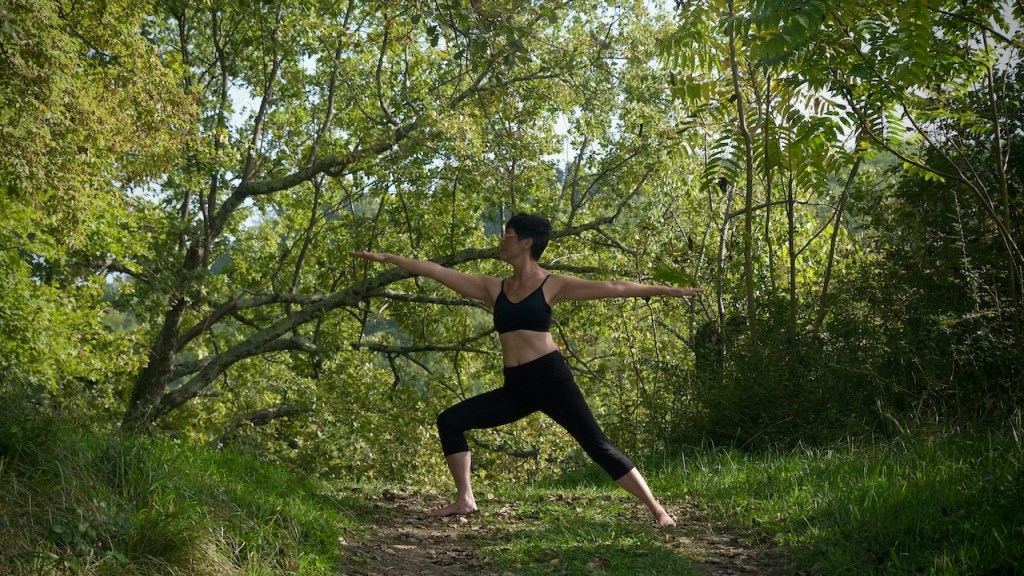
What’s Tantra then? someone asked. To weave, in Sanskrit, Shankari replied. Tantric practices like meditation, pranayama, mudras, mantras, and other purification practices are connected threads that expand our consciousness by awakening the dormant energy. Tantra requires a guru though, not me!
Gratitude, joy, and samadhi! I uttered three words to summarize my feelings, as Chiara and Lorena joined us at the end of Week 1 sharing circle. Few knew that it had been two full decades since I first practiced – and then mostly forgot about – yoga. This training, a total reset, meant so much to my mind and body. One by one, we gave thanks to our fabulous teacher, Shankari, for her spiritual teachings; to Ale, our incredible chef; and to Chiara and Lorena who created such a safe space for healing and growth to happen. Yoga is experience, Shankari said. Yoga training is a path to a higher goal, Chiara shared. Nothing happened by chance; we were a group of eighteen empowered women in the here and now, supporting each other in our transformative journey.

Day 8: Rest Day – Reading Hatha Yoga Pradipika
Yasmina, my dorm mate, and I decided to fast on our first rest day. Why not? It’s all part of the sadhana, cleansing our body, mind, and spirit. Not having read for an entire week, I opened up the tome recommended by Shankari, Hatha Yoga Pradipika, beginning with surprise, surprise, salutations to Shiva and ending in samadhi! Here are a few things I learned.
– To reach enlightenment, hold each asana for SIX HOURS. If this sounds discouraging, skip the rest!
– For Kabalapati, hold your breath for 80 counts. That’s right, EIGHTY retention counts. DO NOT ATTEMPT THIS ALONE WITHOUT GUIDANCE!
– Prana is the ruler of the mind. Hold your breath for this one!
– Meditation is bliss! Not there yet and, between my fractured knee and monkey mind, am not sure whether I will ever reach there!
– The first thing you must always remember before starting any spiritual practice is that the cosmic force is guiding all action and that you are the instrument of that force. Universe, I’m patiently waiting for your next signals!
– Intellect becomes a barrier to spiritual awakening, an we have to find a powerful means of transcending it. Hatha yoga is most effective because you are working on the prana and bypassing the mind. Should I continue or stop reading this thick tome?
– Without thought of the external or even internal thought, all thought abandoned, without even a single thought. Give me some time to think about this!
– Anxieties and worries caused by family and business should be absent during sadhana, such disturbances affect one’s ability to concentrate. Is that why gurus have personal assistants? I need one!
– Behind every sick man there is a spiritual man. Uum, Omm, I guess we are all sick in some ways and have potential to be spiritual. There is hope, everyone!
– There is a Zen proverb, “Before enlightenment – chopping wood and carrying water, after enlightenment – chopping wood and carrying water.” Now back to dirty laundry!

Conked out by 680 pages of dense otherworldly prose, I drifted into a dream state with this one last vibration. If there is no mind there is no time, space and object. Then where is the knower? The knower cannot be known.
Day 9/Week 2. Find your Dharma: We are Yogis, not Broccolis!
I leaned on a wall during meditation to see if I could be more still. Not at all! It felt almost despairing with Shankari’s alarm being the only release. After five rounds each of kapalabati/”fire breathing” and anuloma viloma/alternate breathing, we learned uddiyana bandha/upward flying lock. Standing with the legs apart, knees bent, and the upper body leaning forward, inhale deeply and upon the end of an elongated exhalation, suck the abdominal wall in and up while holding the breath for as long as possible. This is a rejuvenating practice that stretches the diaphragm and eases stomach and abdominal ailments like indigestion, constipation, and diabetes, as well as relieves tension, anxiety, and even depression. Next: headstand again, followed by a modified Sivananda Rishkesh sequence, through bhujangasana/cobra and matsyendranasa/seated twist, ending with trikonasa/triangle balance pose. Mornings had never been dizzy-busier!
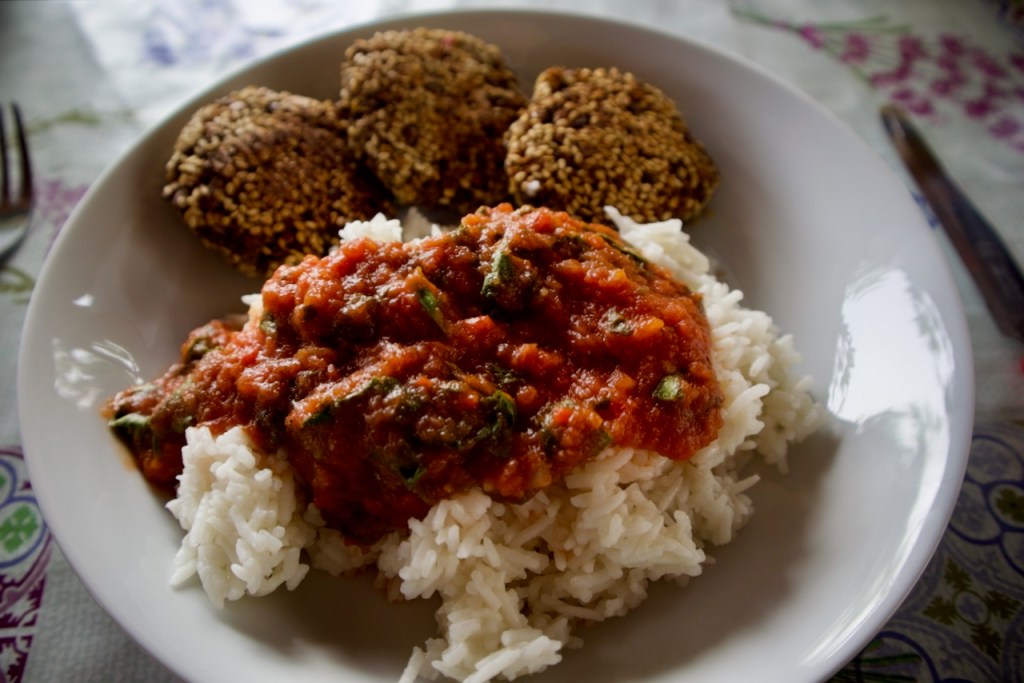
Apple crumble breakfast, our first major dose of sugar since arrival! For balance, the morning topic turned to suffering. They’re all part of yoga, our ignorance, ego, attachment, aversion, and fear of death, the five kleshas/afflictions. Great yogis go to meditation as if they’re going to die, Shankari explained. Why so much fear? Dying is absolutely safe! Ram Dass said. How about pleasure? a classmate asked. For sure! Shankari replied. Life is about balancing between pleasure and transcendence. Anything extreme is bound to fail. Find the middle way. We are yogis, not broccolis!

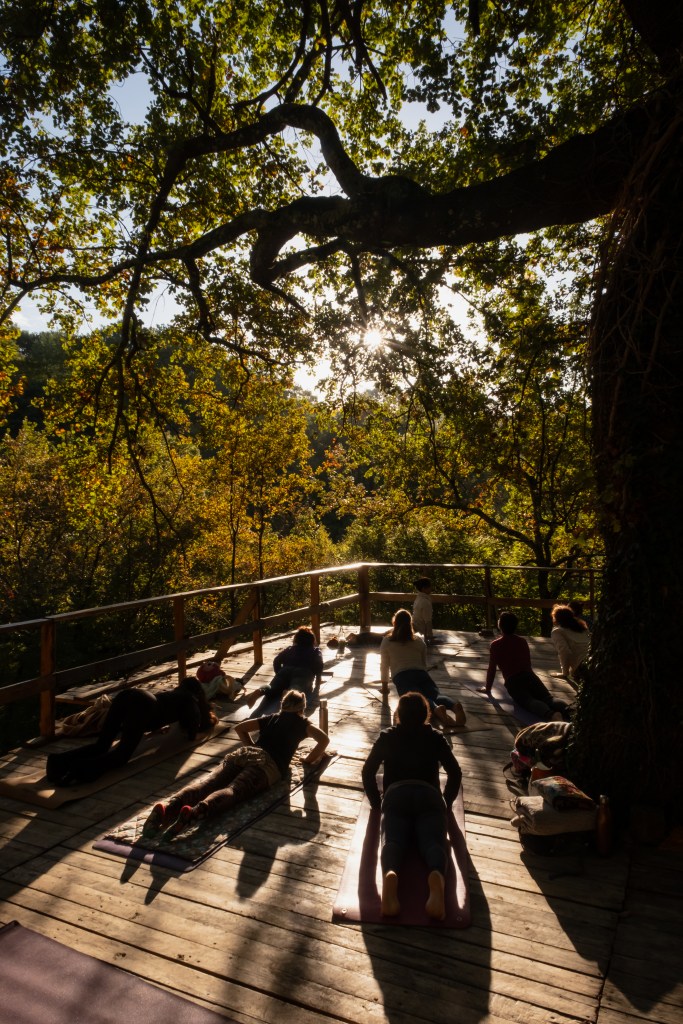
After a lentil-rice combo lunch, the whole class fell tamasic/ lethargic. Shankari led us through a reinvigorating Vyayam sequence based on an ancient Indian martial tradition, ending with nidra/conscious sleep yoga. Lying on that enchanted sun-lit platform surrounded by trees and birds, with church and cow bells ringing, we all drifted to a higher dimension, with quite a few audible snores. I found my calling!
Day 10: Know Thy Body & Full Moon Fire
Once again, meditation and pranayama, followed by Surya Namaskara. Pranamasana, hasta uttanasana, padahastasana, ashwa sanchalasana, parvatasana, ashtanga namaskar, bhujangasana, parvatasana, ashwa sanchalasana, padahastasana, hasta uttanasana, and then back to pranamasana. We all struggled with the Sanskrit names. And when Shankari said, Now come to vajrasana, we looked at each other wondering if that was a diamond, a hero, or a tree!
After a week of yoga philosophy, from ayurveda to ashtanga, chakras to kriyas, mudras to bandhas, it’s time for anatomy. Biology 101: cells and tissues, muscles and bones, skeleton and joints, the esophagus and abdomen, heart, liver, pancreas, glands, nerves, and neurons… EVERYTHING. Yoga builds strength, flexibility, and mobility in all parts of our body, from head to toe, core to sides, front to back. And it’s not just our physical body, but also the astral and causal bodies with ever flowing energy in the 72,000 nadis! No, we are not physicians or even therapists. Don’t even try to diagnose! Shankari reminded us. By now, a few of us experienced serious back and other pain. Hot water bottle, massage, rest, and a pause from the asanas. Listen to your body! our teacher ordered. After going through a long list of contraindications for the major poses – from heart, head, knee, shoulder, kidney, digestive, and abdominal ailments – we finished our day again with highly therapeutic pawamuktasana, strengthening our back and abdominal muscles, toning our legs and arms, massaging our intestines, enhancing blood circulation in the hip joints, AND reducing belly fat. No problem having another yummy high-calorie dinner!

After raining all day, the sky was gracious to clear up for the full moon to make a grand entrance. A yoga teacher from another group led a fire ceremony, making offerings of rice, water, milk, flower, honey to Shiva. We each held two sticks – one to let go of anything that no longer served us and the other with things we would like to manifest in our lives – and put it into the fire. Sometimes the best prayer we make could be just two words, Antonello said. Thank you! With that beautiful vibration, I retired to bed.
Day 11: Balance: Poses and Counterposes
We picked some flowers for the birthday yogi, Yasmina, before meditation, pranayama, and more Sivananda yoga, ending in tadasana/mountain pose for posture and focus.

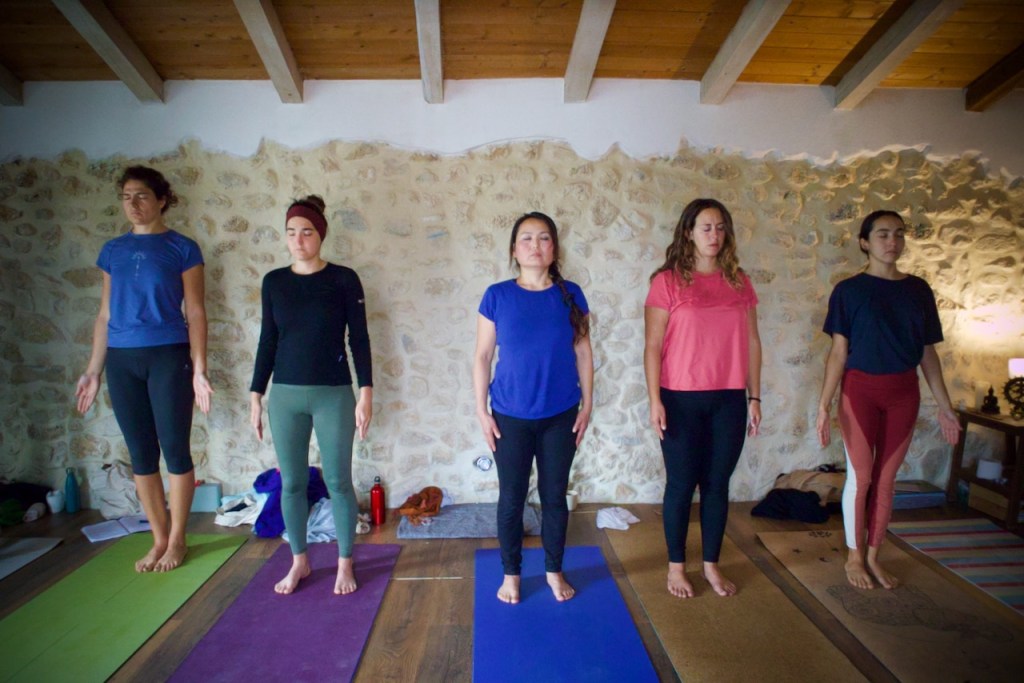
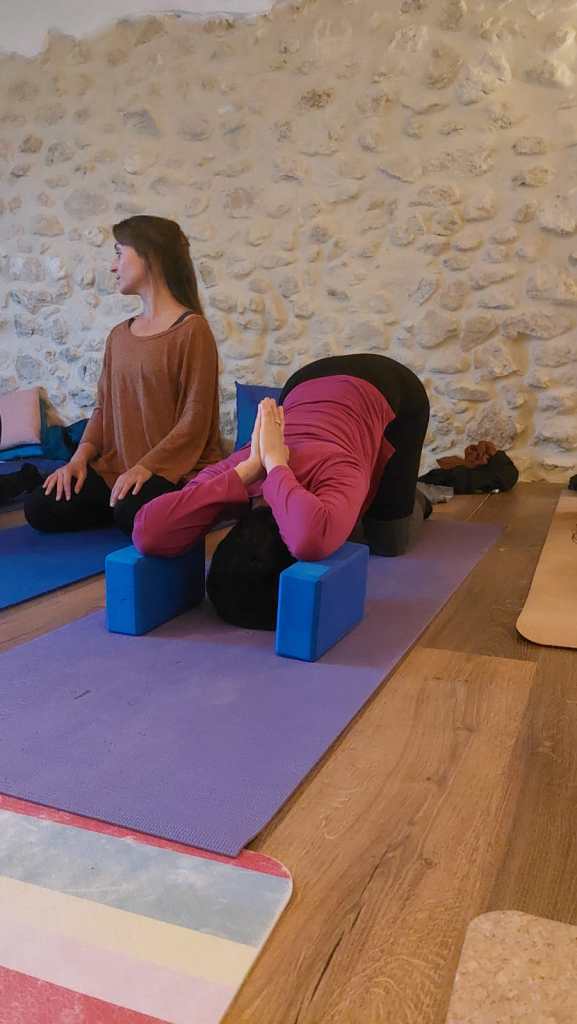
With only ten days remaining in our training, we moved on to teaching methodology. What’s your vision, philosophy, and voice as a teacher? How to get to know each student’s level including any injury and blockages? What about insurance? Remember warm up before asanas and end with relaxation. Be mindful of space and boundary, and offer support and encouragement without side-stepping students’ agency. What kinds of sequences do you want to create and adapt to different student groups? For every pose, balance with a counterpose. Left-right, up-down, forward-back, contraction-expansion. For example, cobra can be followed by either downward facing dog or table top while a challenging wheel pose can be balanced with a comfortable knee to chest bend. When in doubt, use the universal resting balasana/child counterpose that works wonder in reducing stress and anger.

Day 12: Student Teachers
After meditation and pranayama, we drilled into the Surya Namaskara sequence – in Sanskrit – picking up speed and smoothing the transitions. Finally, after practicing without a mirror for over ten days, we paired up with classmates for posture corrections in the afternoon. It’s amazing to find oneself in both roles – as student and “teacher” – realizing where we were standing, sitting, twisting, bending, or even lying properly, aligned or not, what our limits were, and how much we had absorbed everything that had been explained so far. Posture correction is such an art, with the right touch, to the just degree, at the good moment, with appropriate words. Sometimes the best intervention is none, leaving the student to find her adjustment and balance.

Day 13: Take the Plunge: Lead a Class!
We had done the heavenly end-of-asanas relaxation numerous times, but never learned how to guide one. Lie in savasana/corpse pose with no resistance and begin a full body scan, starting with the extremities, Shankari began. The toes and feet, relax. The feet, relax. The hips and buttock, relaxx. The hips, relaxx. The belly and chest, relaxxx. The chest, relaxxx. The back and spine, relaxxxx. The back, relaxxxx. The hands and arms, relaxxxxx. The hands, relaxxxxxx. The shoulders and neck, relaxxxxxx. The shoulders, relaxxxxxx. The face and head, relaxxxxxxx. The face, relaxxxxxxx. The body and mind, RELAXXXXXXX. The mind, RELAXXXXXXX…
By now, we would all be in semi-comatose – or deep sleep – state (gently tap any snoring student!). However much your students want to prolong this exercise, look at the clock and bring everyone back by inhaling, then moving the fingers and toes, arms and legs, stretching the hands up, and slowly rolling over to the left side before returning to a seated position. Release and relaxation are every bit as Important as the asanas.
Do you want to lead a class later this morning, Jennifer? Shankari asked as we wrapped up our morning practice. Wow, I didn’t see that coming, but Sure! I said, ready for the challenge.

All of a sudden, I could no longer focus on my delicious banana chocolate oatmeal breakfast that Ale had lovingly prepared for us, mulling over not only the sequences and poses in Sanskrit, but also the mantras, mudras, bandhas, pranayama, and chakras. Fortunately, Jurtina, the healer in our group, volunteered to go first, giving me an extra hour to dig deep into muscle memory. I showed my sequence to Shankari and she suggested dropping Surya Namaskara. Each of the Sivananda poses including the transitions takes about three minutes. Together with warm up and final relaxation, it would be a full hour. That settled it for my first ever yoga class, at least on paper!

At the eleventh hour, I remembered we had to begin every practice with three Oms, whew! Adding ten tai-chi breaths to kick off, as I had always done in my uni classes, followed by a gentle warm-up, so I began.
Lie on your back in savasana position, inhale, exhale, I began. Now, legs and feet together, shoulders down, chin in, arms together, palms down, in a position of strength. Inhale, exhale, inhale, exhale, inhale, UP, sarvangasana!
I was not doing the inversion myself. Instead, muscle memory as a prof led me to pace around the room – doing nothing else – until Shankari started correcting everyone’s postures. Lesson 1: being a yoga teacher meant multi-tasking: speaking, counting, inhaling-exhaling, leading, correcting, and searching for Sanskrit names!
Hands on your back. Stretch, do NOT move your neck. This pose is great for many things. It strengthens your core, back, neck, and shoulders. It improves your blood circulation, helps sleep, relieves stress, and strengthens the digestive system. Let’s hold for a few more breaths…
Now, lower your left leg to touch the floor; it’s OK if you can’t reach it. Inhale and slowly come back up. Exhale, the right leg down… Now, both legs down in halasana. If they touch the floor, release and interlock your fingers at the center of your back. Hold it there. For those we want a little more stretch, bend your knees and pull them close to your ears (I can never remember this pose in Sanskrit!). Release, back to savasana. Relax your arms and legs, gently turn your neck to let go of the tension…
What’s next? I asked myself. Oh, yes! A counterpose: matsyasana/fish! And so I more or less led through the Sivananda sequence, ending with a fifteen-minute relaxation body scan. RELAXXXXXXXX, I repeated, and made sure not to forget the three Oms and three shantis/peace before namaste-ing/thanking everyone.
What a wondrous experience! Despite my gaps in Sanskrit and pose transitions, I thoroughly enjoyed improvising my first yoga class, feeling like a butterfly emerging from its chrysalis.
Day 14: Easing into the Asanas
We drilled into the Sivananda sequence again but with variations through cobra and baby cobra, seated twists, and eagle, warrior, and tree poses for balance. After lunch, the professional dancer in our group, Monia, gave a beautiful class, beginning by dusting bad energy off our body before easing into pawamuktasana and then directly into halasana/plow pose. She was a natural, leading everything with grace and elegance, from fish to cobra, bow to crow, triangle to mountain. Always mindful of contraindications, her favourite refrain was – Do not practice this if you have high blood pressure – and the whole class would break into laughter!
Next, Gaby, the youngest in our midst, began a therapeutic sequence with a hip-opening butterfly, downward-facing dog… before holding in what felt like an eternity in three legged downward facing dog before, and ending with a meditation on forgiveness. What maturity for a 23-year-old!
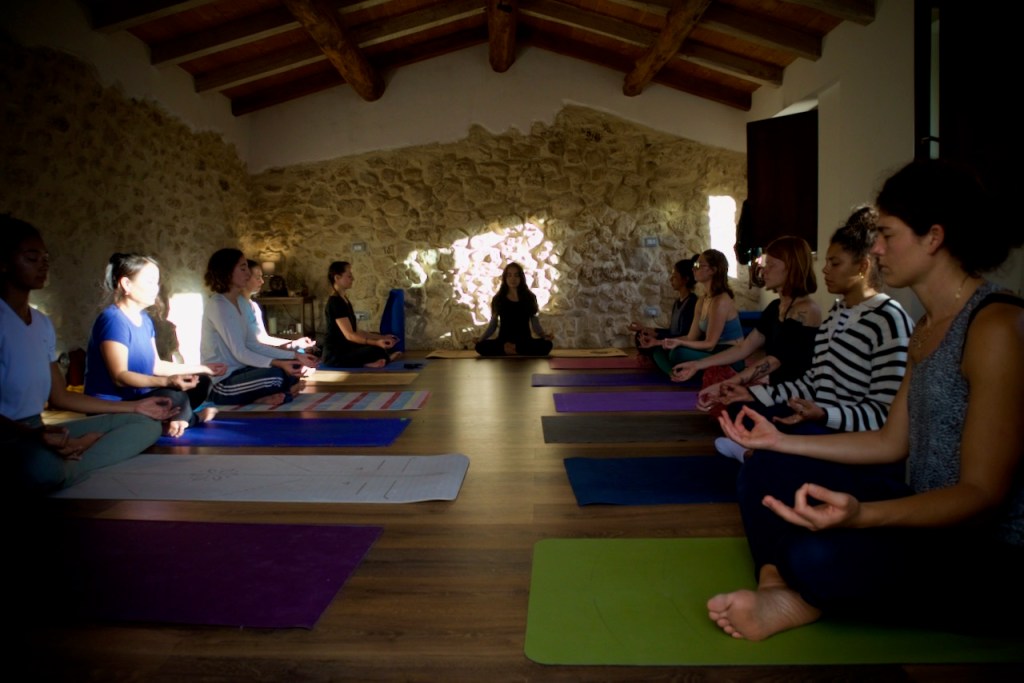
Lorena and Chiara again joined us in the end of Week 2 sharing circle. Most of us felt more presence, confidence, and gratitude while a few struggled with suddenly released blocked emotions. You’re still my favourite group, Chiara said smilingly. Lorena appreciated our group’s beautiful energy. For me, it had been one of the most beautiful experiences in my life, like a dream. Whereever you will be, keep this with you – this will be a gift for me, Shankari said. Om, Om, Om, shanti, shanti, shanti!
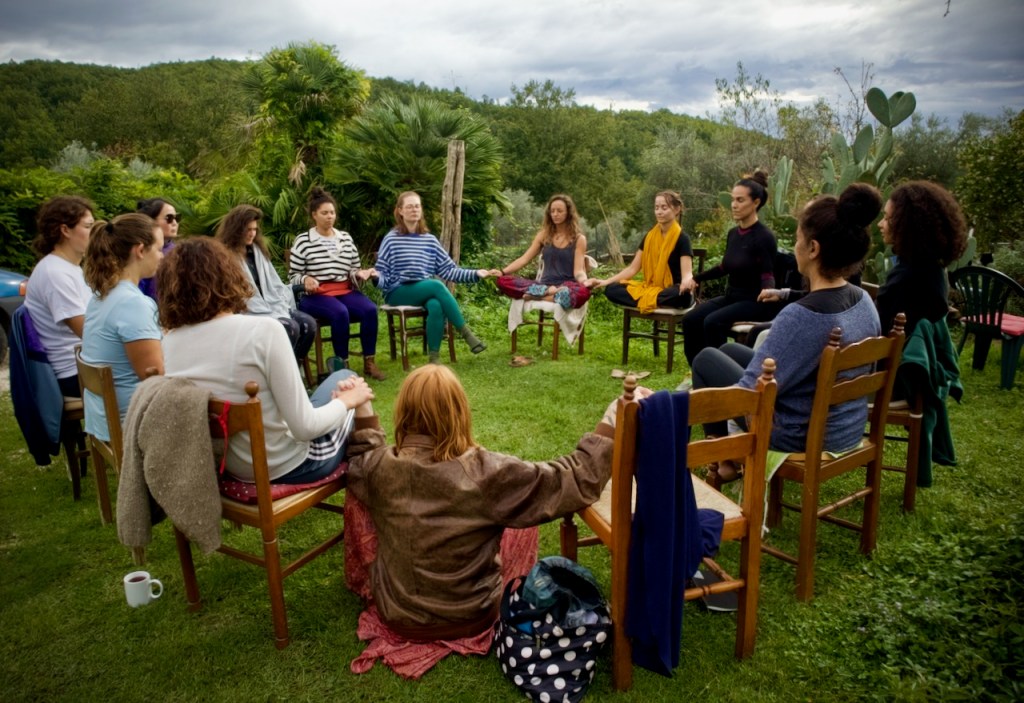
Day 15: Workout on Rest Day
We ended up having a dynamic rest day morning, as Chiara, a professional fitness trainer, gave us an all-joints opening full workout. Yasmina and I took a leisurely stroll to Sora while the rest of the gang headed to town for a real Italian pasta lunch plus gelato. I succumbed to a tamasic three-hour-long nap, missing Monia’s contact improv class as well as a cha-cha-cha lesson that I was supposed to lead. There were so many talents in our incredibly fun and empowered group of eighteen that even our rest days were happily filled!
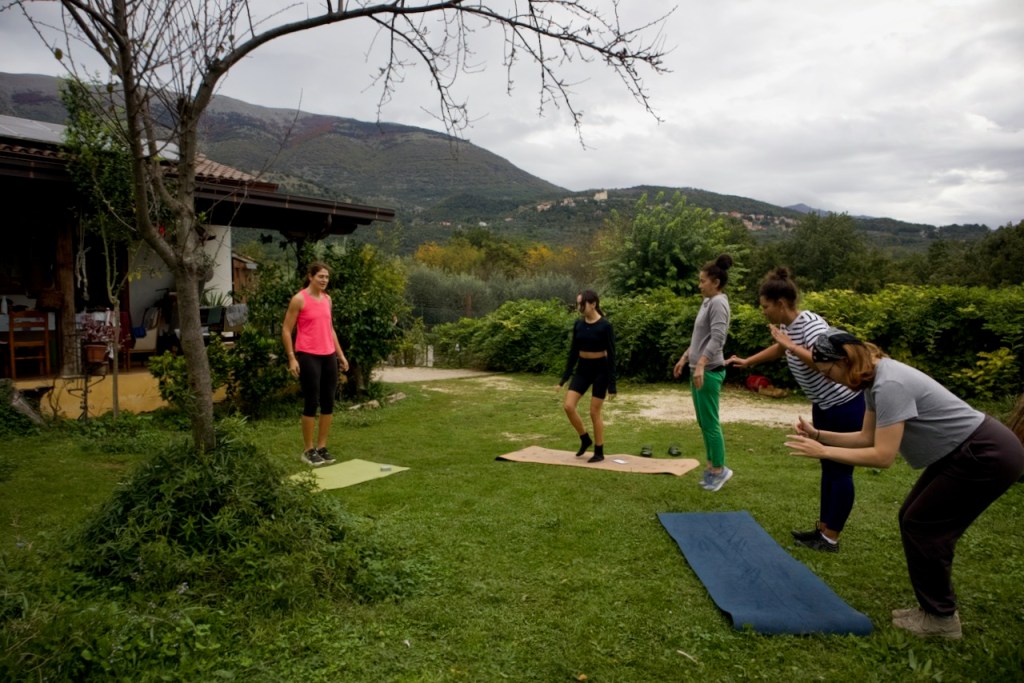
Day 16/Week 3. Find Support Whenever You Feel Pain
I settled on a block to ease pressure on my right knee and the numbness improved. Find support whenever you feel pain!
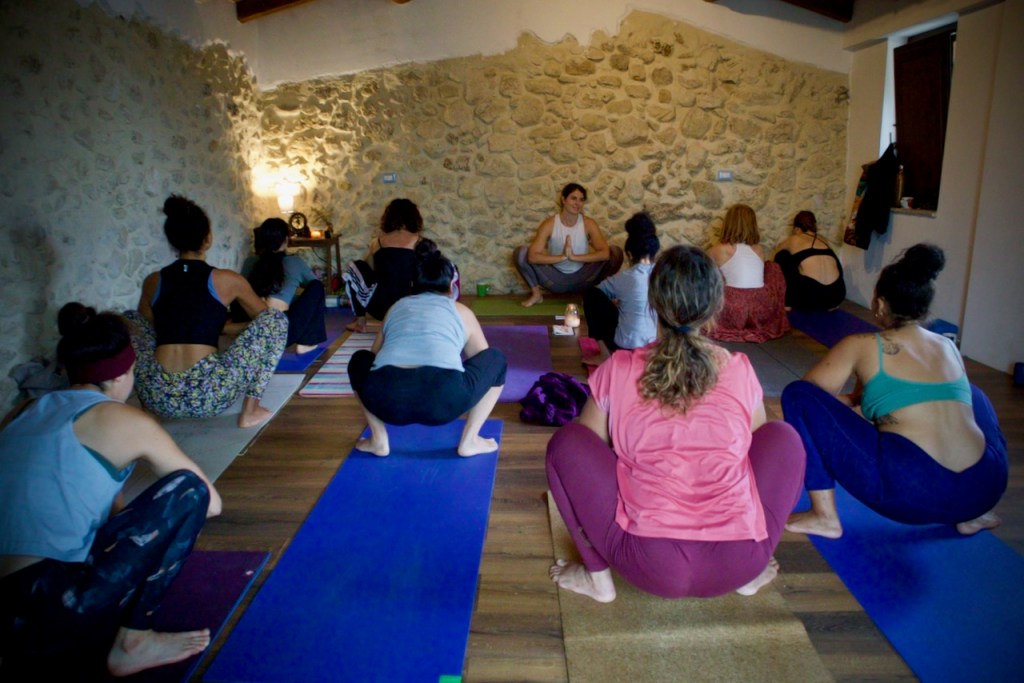
One by one, Tina, Sara, Elise, Dasha, and Radana led class, all with their full personality. Tina chose the theme of introspection and introduced a beginner’s sequence through cat to warrior poses. Sara combined her interests in taro and yoga, drawing a card on La Force/Strength – featuring a lioness with an open jaw – with a dynamic progression from chair to chaturanga, cobra, and warriors.

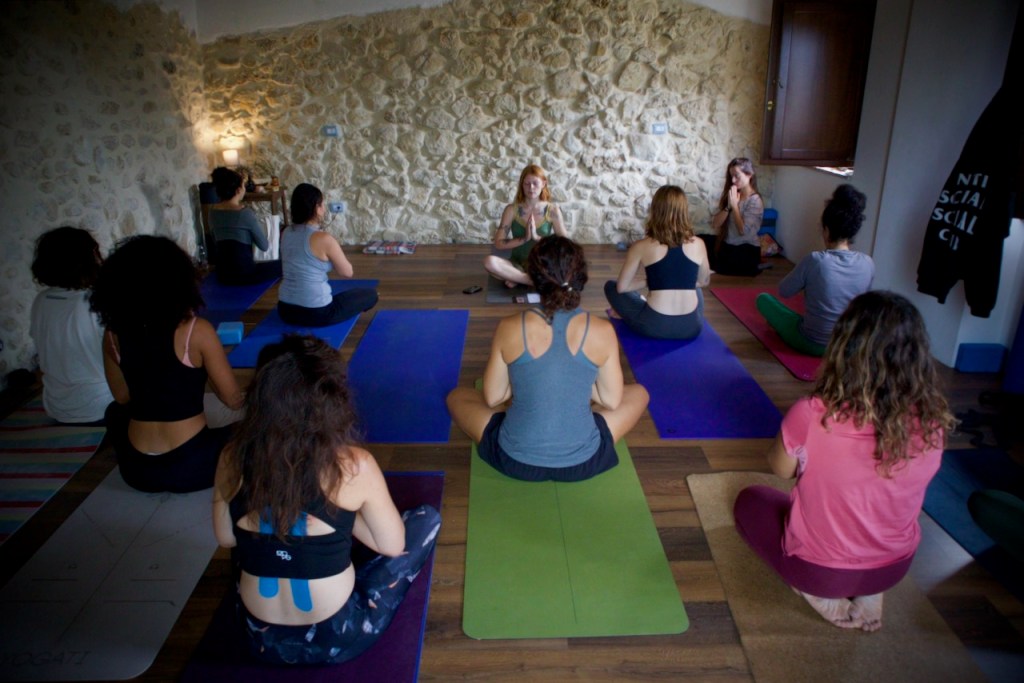
Beautiful Elise led us with her angelic energy from needle to cat, warrior and table poses. Dasha, strong as a mountain, guided us through pawamuktasana and relaxation. Finally, Radana, our class photographer, began with a hip-opening malasana squat and onwards to warrior poses despite her excruciating backaches.

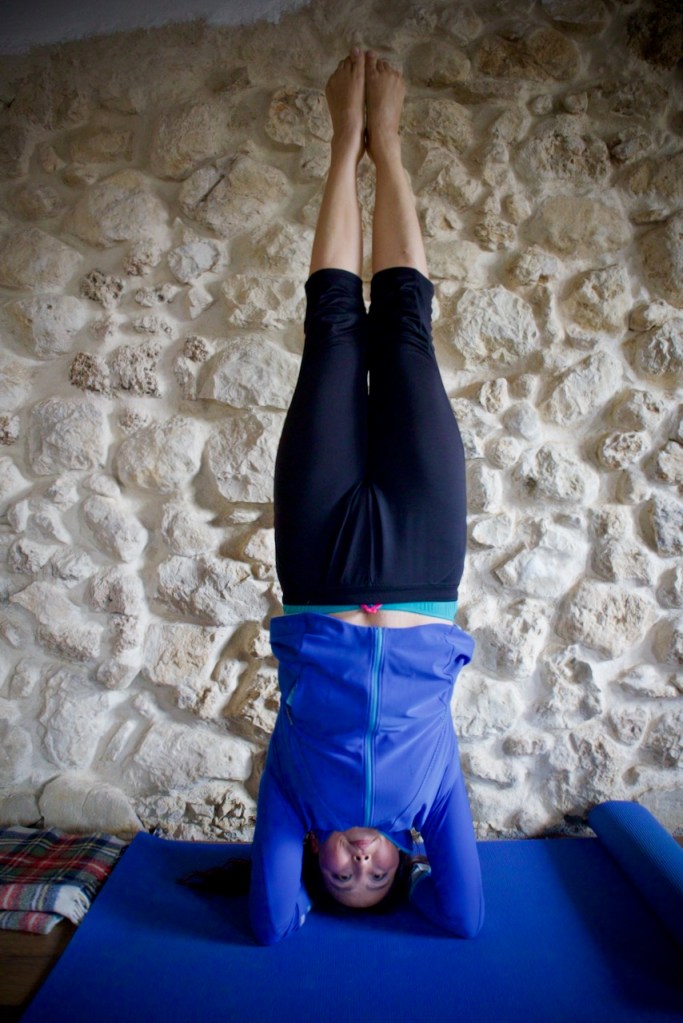
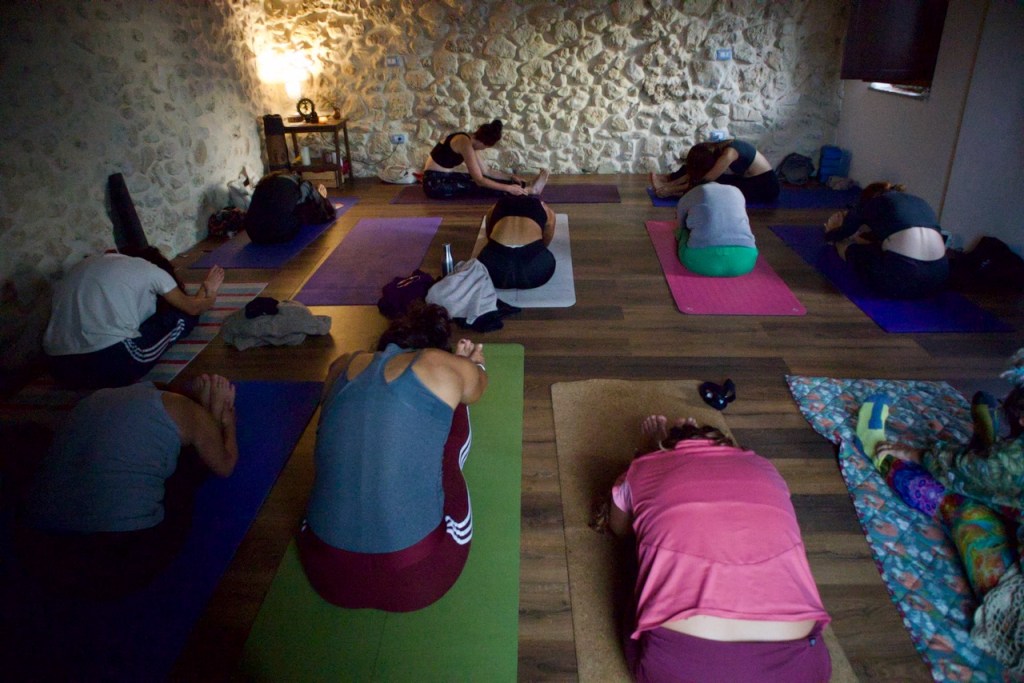
What a day, with five full hours of asanas and plenty of beautiful memories, seeing each classmate bring learning to fruition in such inspiring unique ways!
Day 17: Yoga Quiz
Befitting to her fitness background, Chiara led a robust sequence this morning from malasana/garland to warrior and lord of dance poses with a strong core, rotating between the “chocolate” (stronger) and the “lemon” (weaker) sides of the body (a German expression apparently). Confidence is a pathway, she said, knowing fully what she’s talking about.
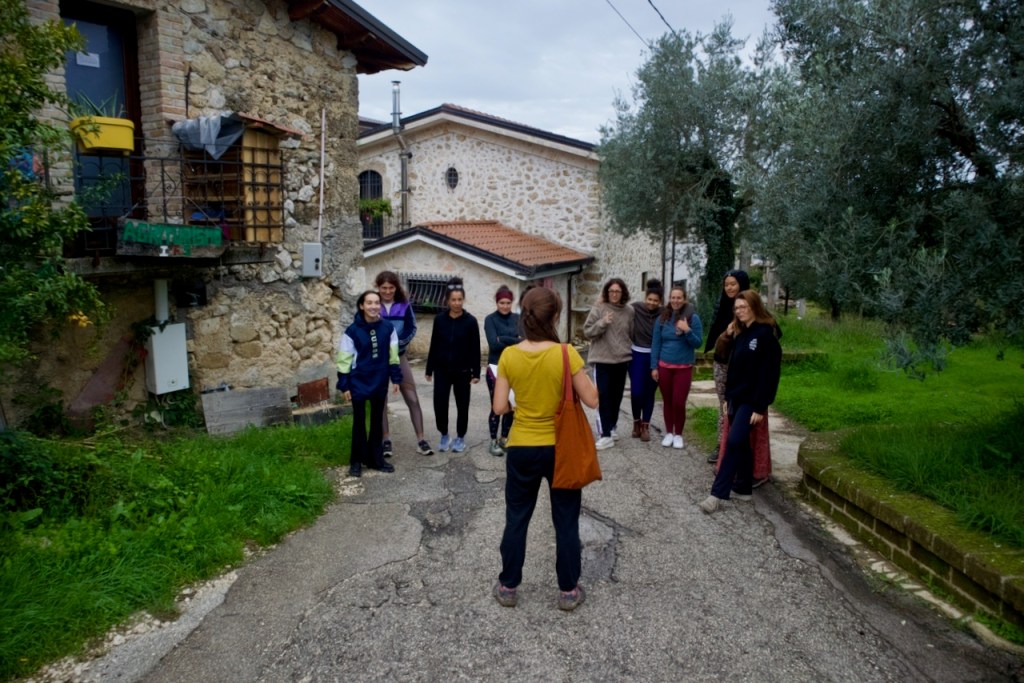
To ensure that we had learned and absorbed everything properly, Shankari designed a yoga quiz/game after breakfast – with peanuts as symbolic reward points – that would take us through the farm to look for clues and test our memory. What’s the definition of yoga? she asked. Citta vrtti nirodhah! Jackie replied. One peanut point! What’s a yantra? Shankari asked. A vessel, Gaby said. Another point! And the definition of asanas? Stillness of the mind, stability of the intellect, and benevolence of the spirit, I shouted. Alas, few could recognize the manipula/solar plexus yantra, and none could recite all five yama/behaviour and five niyama/attitude in Sanskrit. Eh, ahimsa, satya, and…? Not crostata, margherita, or parmigiana!
The most memorable was definitely the epic endurance test in which Monia, the dancer, and Jurtina, the healer, out won by standing in vrkasana/tree pose for a total of twenty-five eternal minutes, at the risk of damaging their hip nerves, for one peanut each! What stamina and determination! I co-won the second endurance test in warrior pose, thanks to those years of competitive ballroom dancing thickening my calves. The predominantly Italian group won with home turf advantage, amassing over 40 peanuts!

Before the day ended, Lorelei, with her strong pilate training, put together a challenging sequence from utkatasana/chair pose to pyramid, warrior, and utthita hasta padangusthasana (extended hand-to-big-toe). Finally, Jackie wrapped up with a 30-minute relaxation with her favourite song, Nomvula/After the Rain. As we lay there in savasana, she brought us to her homeland in South Africa and reminded us of the freshness after the rain, breaking barriers, forgiving, moving on…


Day 18: Hips Don’t Lie!
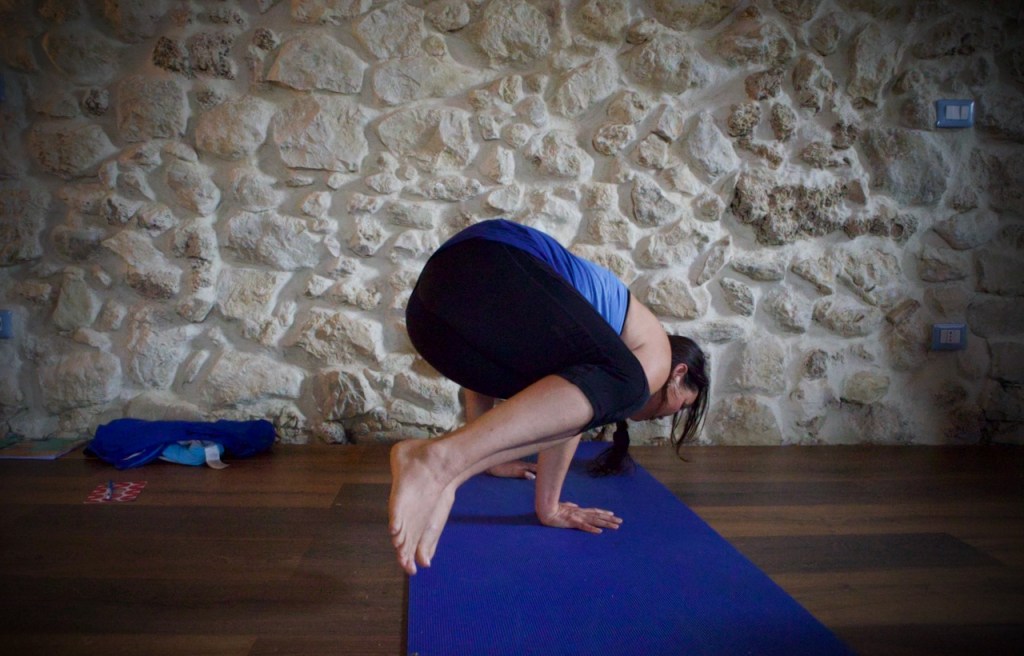
On our last day before the exam, Dasha volunteered to lead another class, harder and longer than the first, through the Surya Namaskara B sequence with warrior 1, 2, 3 as well as the high lunge before moving directly to sarvangasana/shoulder stand, bhujangasana/cobra, and kakasana/crow poses! Hips don’t lie, eh! she said, as she saw us struggling. You bet!
We took advantage of our last free afternoon taking a few photos in the beautiful garden, chilling in the soft autumnal sun. Shankari led us through one last round of pawamuktasana and warrior poses, ending with meditation. Seeing that I still struggled to sit still, she quietly handed me a block. When in pain, find support! Sweet Jurtina gave each of us a citrine necklace to wish us luck tomorrow. We rehearsed the Shiva chants – expected in the exam! – as Radana played drum well into the timeless evening.
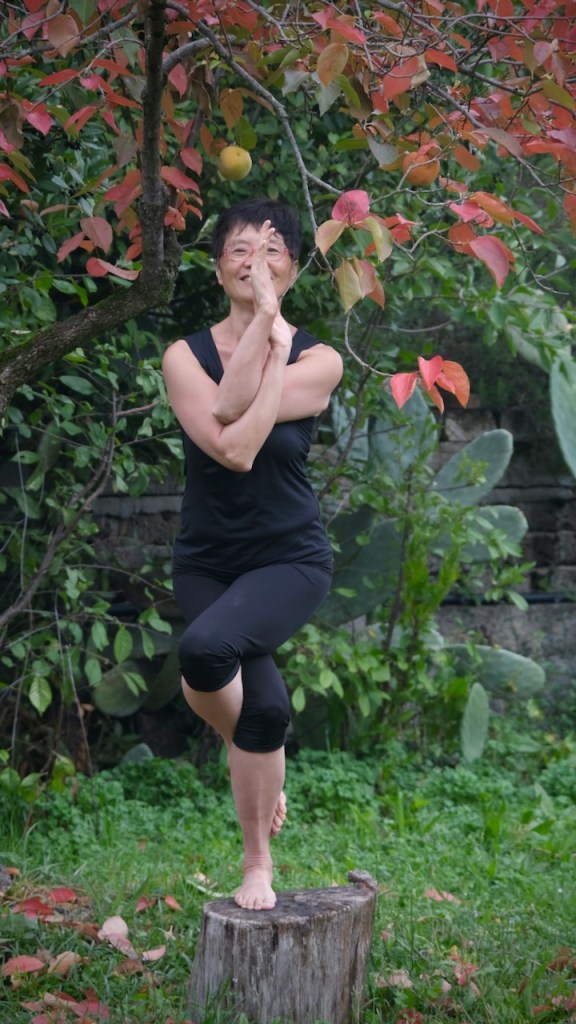
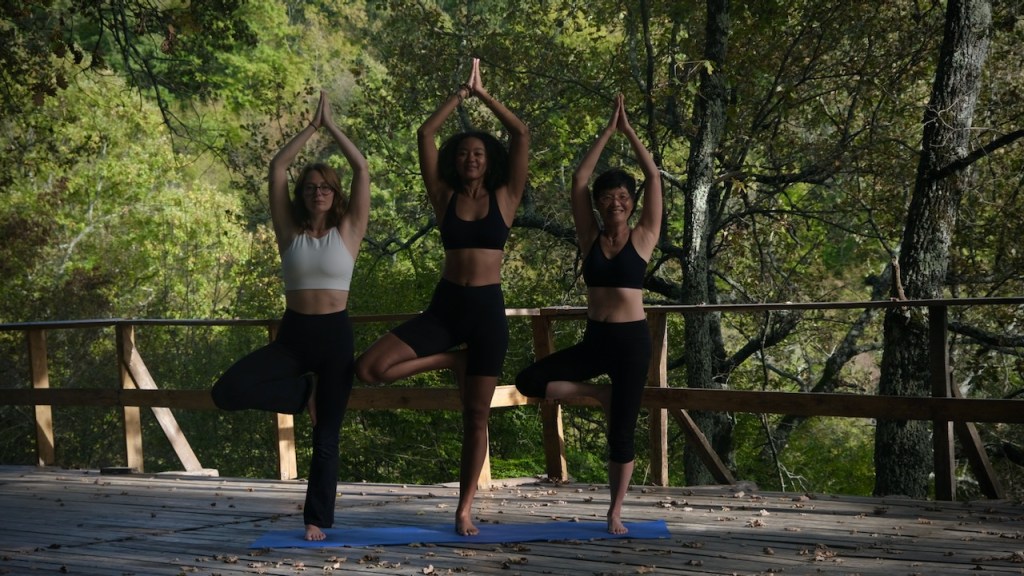
Day 19: Final Exam
Finally, the end was near. How many days before we head home? Dasha asked me in the morning. Only two, I said. After breakfast, we were paired for the final assessment, taking turns to be the student and teacher. Shankari asked me to lead the pawamuktasana sequence, then surya namaskara, the three last standing balance poses of the Sivananda Rishikesh sequence – trikonasana/triangle, vrkasana/tree, and tadasana/mountain – yogic breathing, and guided meditation. Whew!
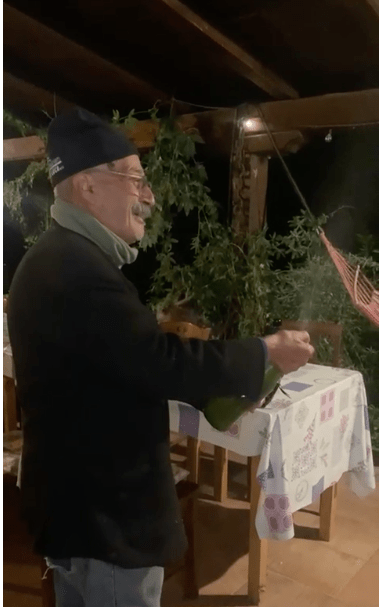
What a mixture of feelings when it’s all over – joy, relief, happiness, confidence, optimism, hope – as if a major threshold had been crossed, ushering one into a brand new territory. Alexandra prepared us a feast with home-baked crackers and eggplant dip, and in-season roasted pumpkin soup. Giuseppe, Antonello’s father, gifted us a huge bowl of frozen fruit punch and opened his very own vintage sparkling. The mousse sprayed everywhere and we gave out loud bouts of yogic laughter. It was straight out of a Fellini film set!
Day 20: Graduation Ceremony
I looked at my notes and realized this was the only day with no entry. Everything that Shankari shared in our last vyayam practice was so deeply moving that I must have committed it to memory.
The rain, the snow, even earthquakes come, but the mountain is still there, standing tall. Men might try to change it, but can only touch the outside. The inner strength is always there…

Find a tree, feel its prana, draw it in, and in turn give out yours to her. You and her are one…

Standing relaxed, move your hands gently up and down, like sieving rice, hearing the sounds, feeling the texture, smelling its fragrance, and feeling full from its sustenance. You know it so well that you are the rice. You and the rice are one…
Walking like a samurai – in a dragon way – with our core unmoved. We’re strong, in combat mode…
We salute our worst enemy – our mind – and our masters and teachers for their gifts; surya for her generous life force and the moon for calming our energy; and everyone and everything…
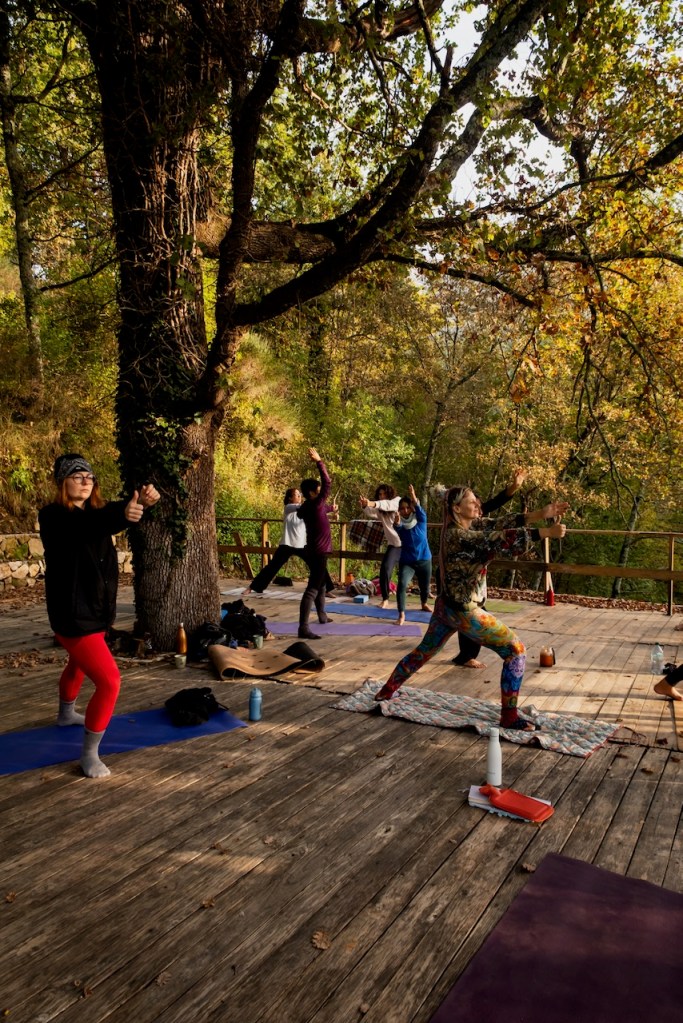
While you’re breathing in, your friend is exhaling. The trees are absorbing your carbon dioxide to live, and the birds depend on the trees for life. Everything is connected…
I still feel the vibrations from these beautiful teachings as I write this, far from the farm and everyone now. To close our training, Lorena and Chiara arranged an “angel’s walk.” Again, by chance or not, I was the first one to go, blessed with everyone’s murmuring wishes. And to top it all, we being in Italy, the bouquet finale of our YTT was naturally home-baked pizza in the once abandoned village of Antonello. Pleasure and transcendence, ideally in that order! Antonello’s right: sometimes the truest and deepest words we can utter might simply be: GRAZIE MILLE!
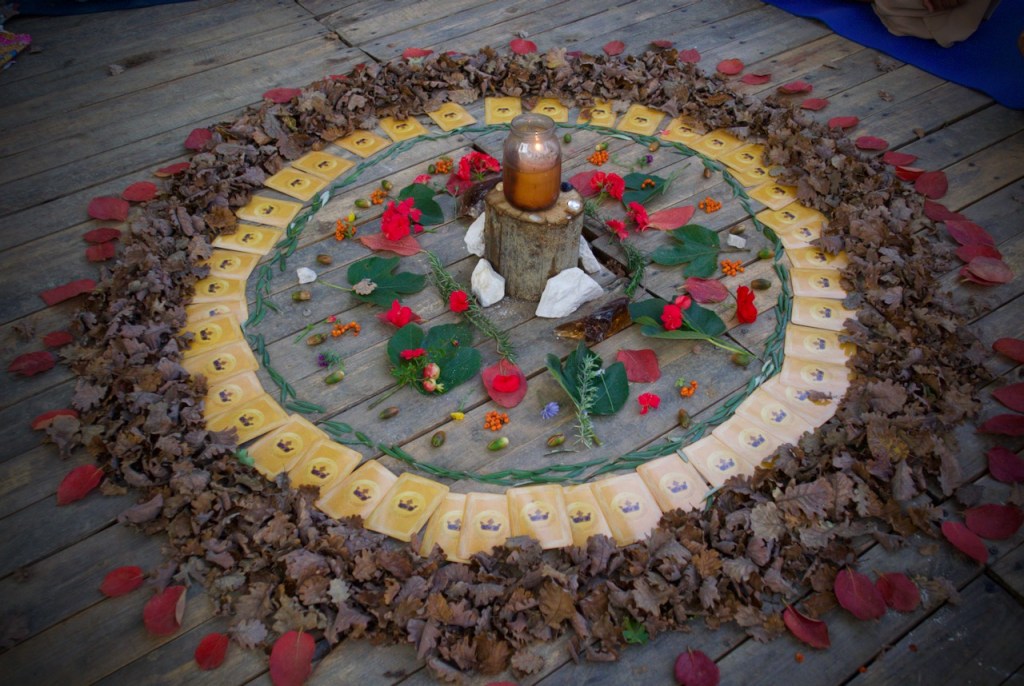
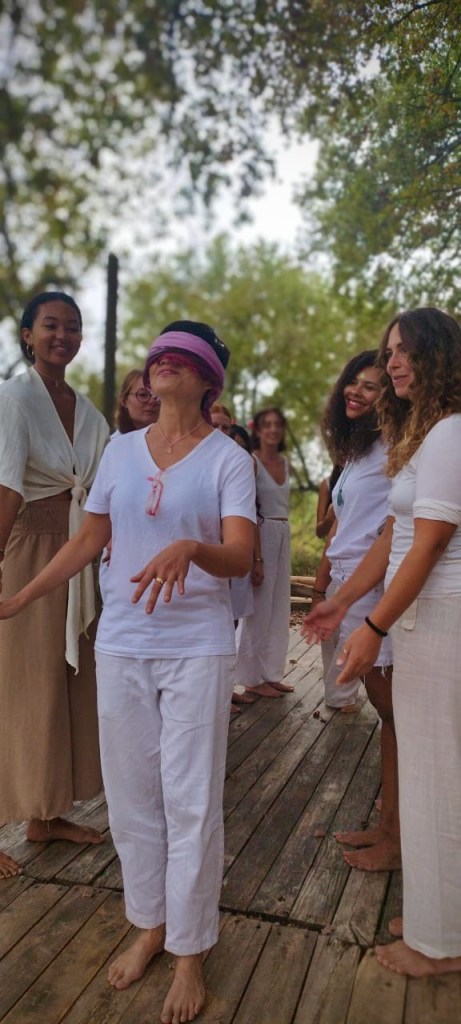
Three weeks of learning to breathe and sit still, focus and concentrate, accepting and letting go. What a journey of challenge, growth, and transformation, through full moon and birthdays, job loss and heartaches, pain and strength. My deepest gratitude to Shankari, our amazing teacher, who gifted us far more than yoga. Whereever I will be, I’ll keep this experience with me – this is your gift for us. And to Chiara and Lorena of Trikona Yoga who made the training not only accessible but enjoyable; to Alexandra for all her gourmet meals and nourishment; and to the entire graduating class of YTT October 2024 for your infectious cheers and support. We are yogis, not broccolis!
Ommm, Ommm, Ommm, shanti, shanti, shantiiiiii. Namaste!
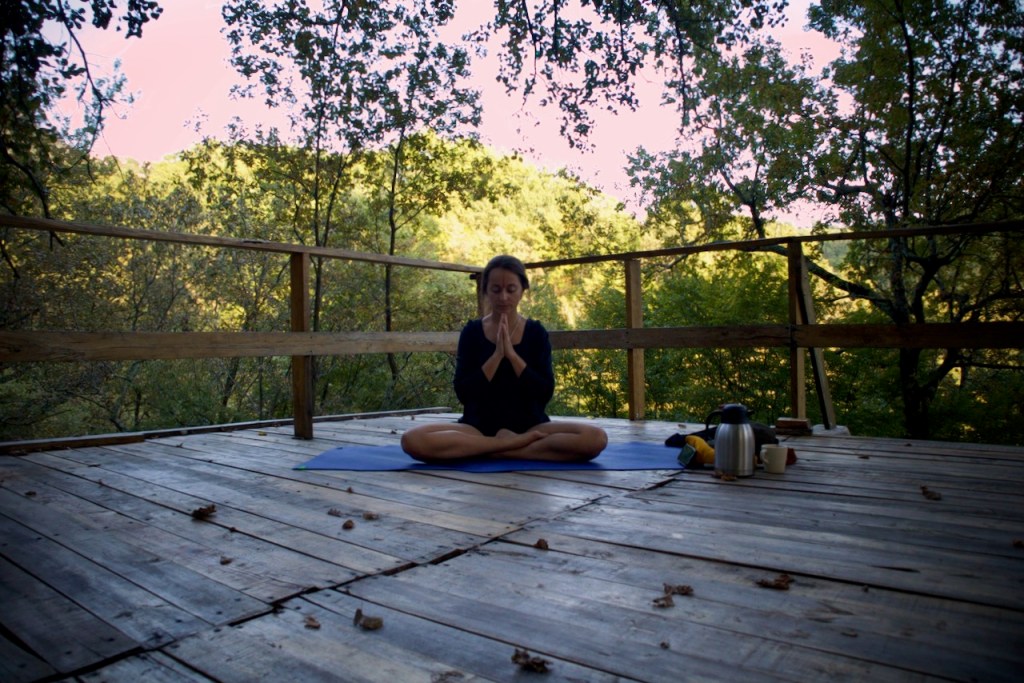


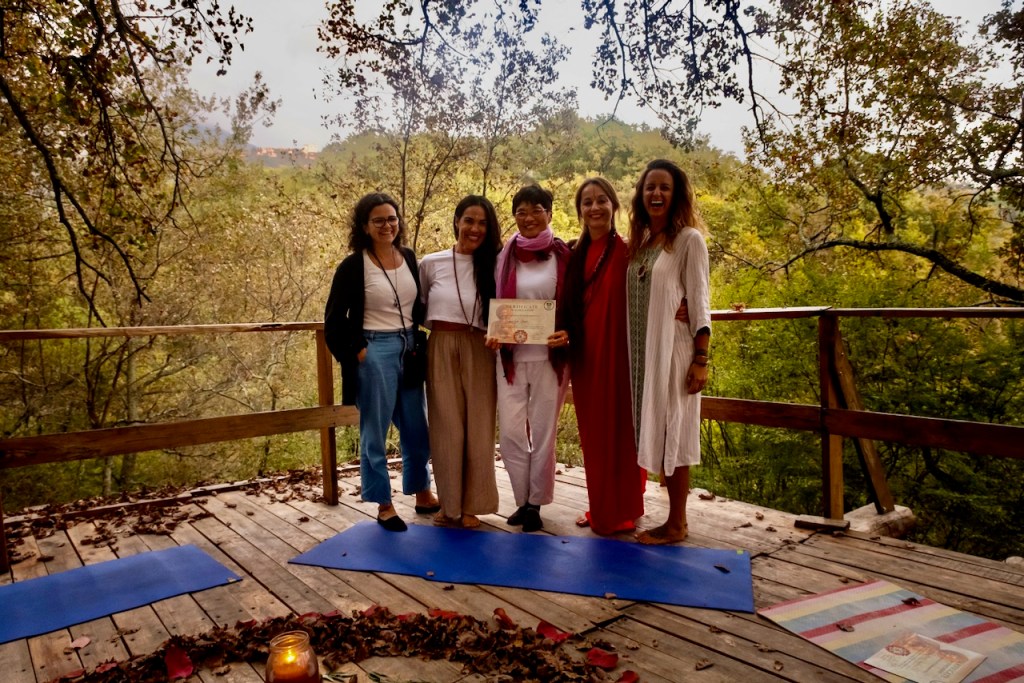


A living mind is a still mind.
It has no center, therefore no space and time.
Such a mind is limitless.
That is the only truth, that is the only reality.
-Krishnamurti, Freedom from the Known
All Content © 2026 by Jennifer Chan
 Jennifer Chan Photography